
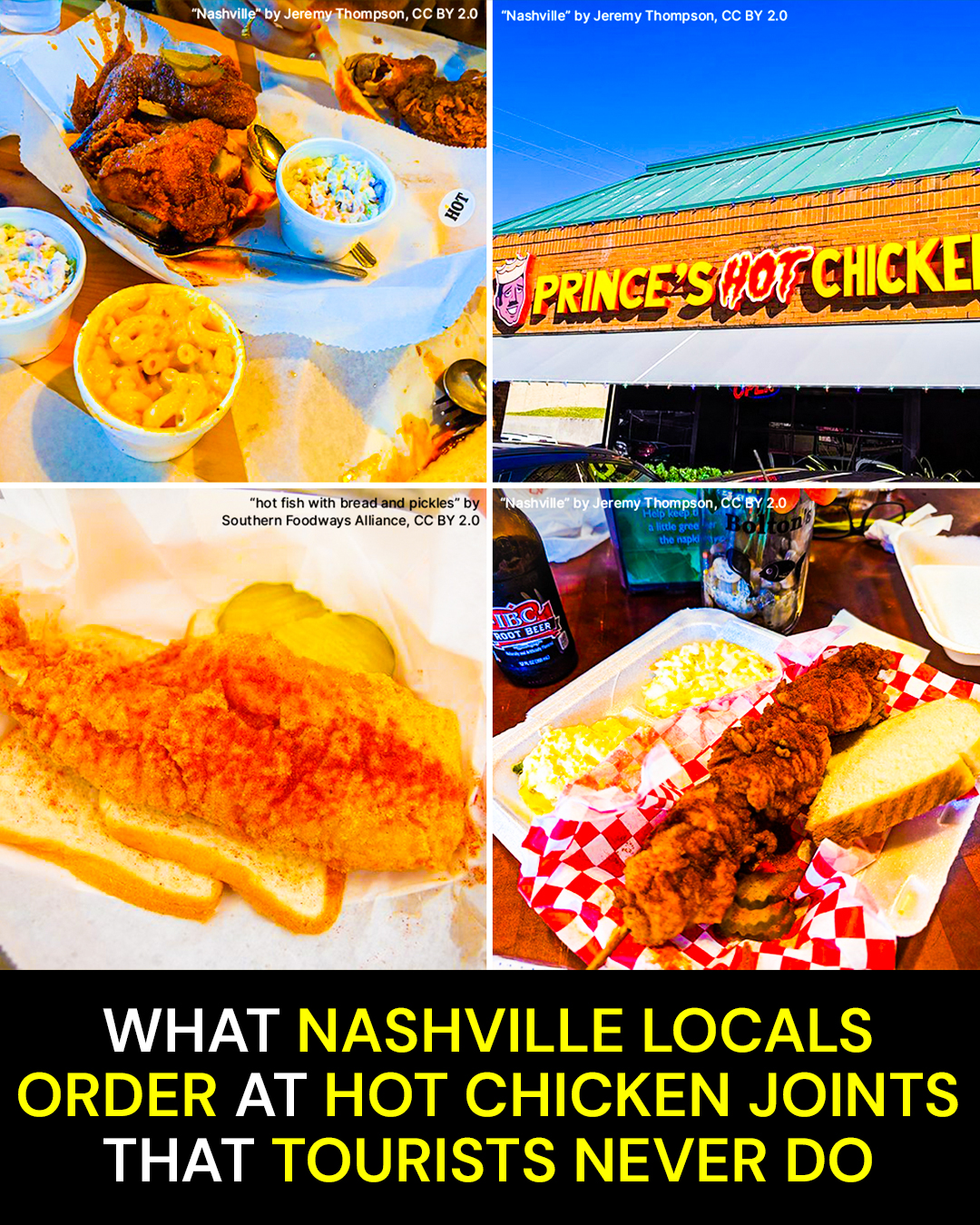
Visitors can spend an entire Nashville lunch chasing the hottest chicken on the menu and leave having barely tasted the thing they came for. The smarter order is often less dramatic: dark meat, the right heat level, white bread, pickles, and a side that actually belongs on the plate.
After comparing current menus, local dining coverage, restaurant histories, and Nashville diner recommendations, a pattern appears. Tourists often order hot chicken like an attraction. Regulars order it like lunch.
The Dark-Meat Order That Tells You Prince’s Is Not Just Another Chicken Shop
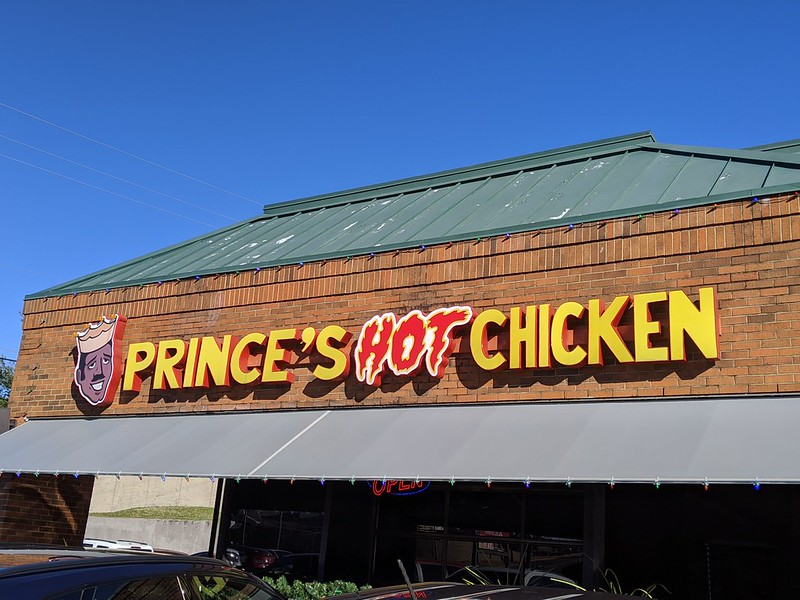
Prince’s Hot Chicken is where any serious discussion of Nashville hot chicken has to begin. The restaurant is widely recognized as the birthplace of the style, and its current menu still revolves around old-school choices including breast quarters, leg quarters, whole wings, and tenders.
But the order worth noticing is the leg quarter.
That means thigh and drumstick together. You get more dark meat, more richness, and plenty of skin for the seasoning to cling to.
It also feels very different from biting into a tidy chicken sandwich.
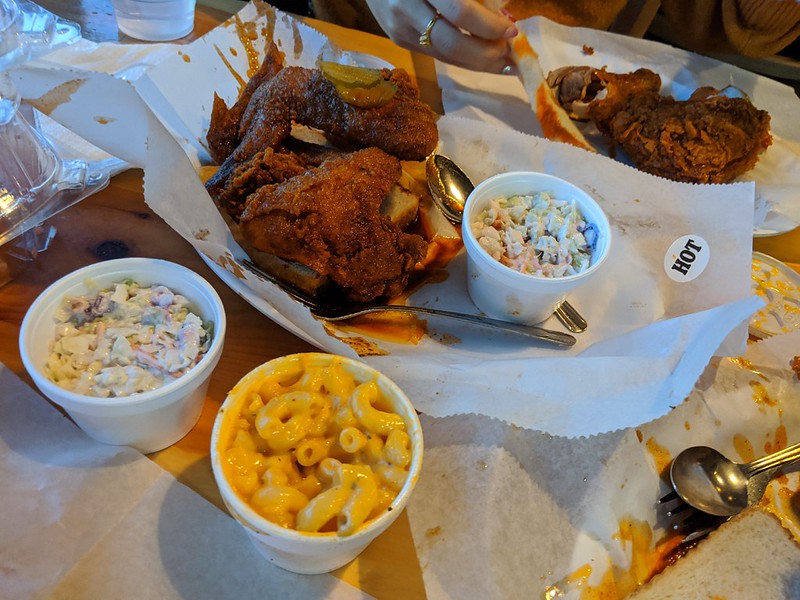
The plate arrives looking almost stubbornly plain. Chicken. White bread. Pickles. No towering bun designed for a photograph. No need for six toppings to announce themselves before you taste the bird.
Then you pull apart the thigh.
The crust cracks. The meat underneath stays juicy. Seasoned oil works into every ridge and fold of the skin. The bread underneath slowly darkens where the drippings hit it.
Here’s what catches people off guard.
At Prince’s, knowing which piece of chicken to order can matter more than proving how much heat you can survive.
The insider move is a leg quarter at a heat level you can actually enjoy, with the bread and pickles left right where they belong. Prince’s ordering system has also offered a “fried hard” option, a small customization repeat customers may notice before casual visitors do.
Don’t automatically default to tenders because they’re easier to eat. Dark meat is naturally richer and better suited to a meal built around fried crust and assertive seasoning.
And don’t treat the white bread as packing material. Its job becomes obvious after the chicken sits on it for a few minutes.
The trap is assuming the biggest decision at Prince’s is the heat level.
It isn’t.
And at the next old-school Nashville institution, the bigger surprise is that the smartest order might not contain chicken at all.
The Hot-Chicken Joint Where Regulars Know to Order Fish
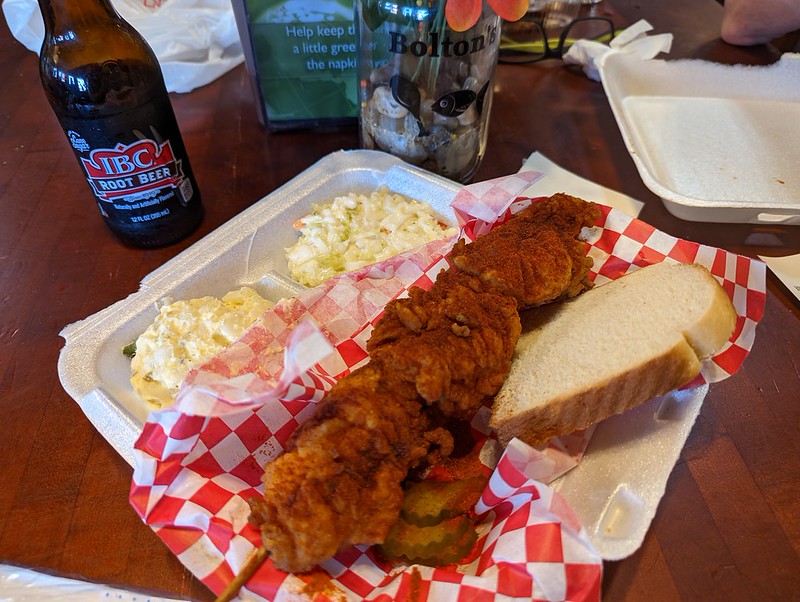
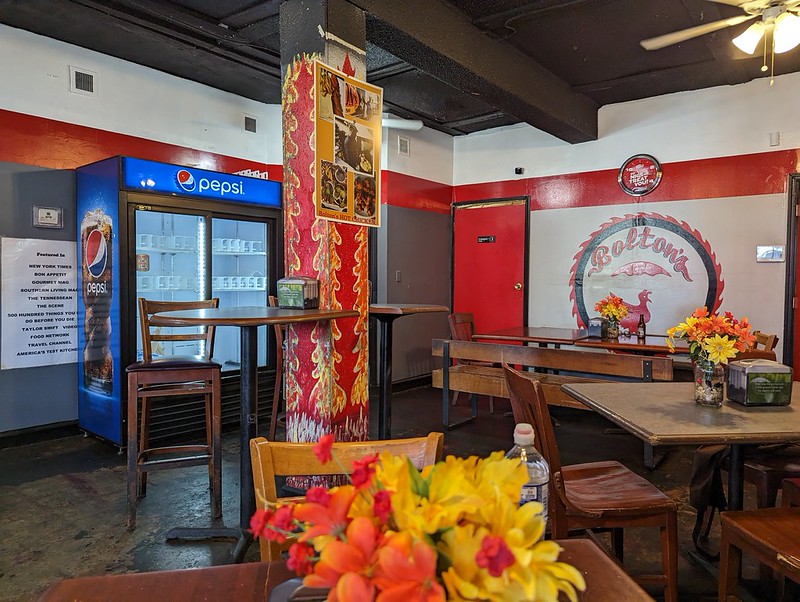
Bolton’s Famous Hot Chicken & Fish puts the clue right in its name.
Along with leg quarters, wings, tenders, and chicken on a stick, its menu includes catfish and whiting. Nashville dining coverage has long treated the hot fish as a major part of Bolton’s identity rather than some forgotten menu add-on.
Walk in expecting nothing but poultry and this can feel like somebody handed you the secret menu.
Whiting takes especially well to this treatment.
Instead of the heavy bite of a thick piece of chicken, you get delicate fish under a seasoned crust. The inside flakes apart quickly while the exterior carries the spice.
Then come the old-school accompaniments.
Nashville’s hot-fish tradition has included mustard, onions, pickles, and plain white bread, a combination that sounds almost too simple until you understand what each piece is doing.
The mustard brings sharpness. Onion adds bite. Pickles bring acidity and crunch. White bread catches whatever falls.
Here’s what catches people off guard.
One of the most Nashville things you can order at a famous hot-chicken restaurant is fish.
If you’ve never eaten at Bolton’s, resist the urge to demonstrate your spice tolerance. Bolton’s own guidance warns that even Mild carries real heat.
That makes Mild a knowledgeable order, not a timid one.
Pair the fish with potato salad or baked beans if you want contrast instead of piling heat on top of heat.
The trap here is bringing another restaurant’s heat scale with you. Nashville hot-chicken shops do not share one universal definition of Mild, Medium, or Hot.
Learn the restaurant before trying to conquer it.
That rule becomes even more important at a place whose very name seems to dare you into making a bad decision.
The Restaurant Where 400 Degrees Is a Name, Not an Instruction
400 Degrees creates one of Nashville’s easiest tourist traps without doing anything wrong.
The restaurant is called 400 Degrees.
Of course newcomers want to order 400-degree chicken.
But current ordering data has shown popular choices at 100 and 200 degrees, including leg quarters, tenders, breast quarters, and whiting. The restaurant’s menu also stretches beyond chicken into fish, shrimp, and pork.
That tells you something.
People who know a restaurant don’t necessarily keep climbing its heat ladder. They figure out where flavor and pain stop cooperating.
At 100 or 200 degrees, the experience can become less about survival and more about the actual food. You notice the crust. You notice the seasoning. You notice the richness of the meat instead of spending lunch staring into the middle distance wondering why your ears feel hot.
Then there is the pork chop.
A seasoned pork chop is not what most travelers picture when somebody says, “We’re going for Nashville hot chicken.”
That’s precisely why it belongs in this conversation.
Nashville Scene has praised 400 Degrees for balancing flavor with pain and has also highlighted the seasoned pork chops and fries.
Here’s what catches people off guard.
Some of the most interesting orders at 400 Degrees are 100 or 200 degrees, and one of them is not chicken at all.
The insider move is to choose a heat level based on eating the whole meal, not winning the first bite.
There are much hotter possibilities associated with the restaurant, including extreme off-menu levels reported for serious chile obsessives. Those make great stories. They do not automatically make a better lunch.
The trap is assuming lower heat means you’re getting a watered-down Nashville experience.
Quite the opposite.
Sometimes backing down the heat is how you finally taste why people love the place.
And that same lesson applies at Nashville’s most famous modern hot-chicken chain, where locals and tourists overlap far more than people like to admit.
The Famous Hot-Chicken Chain Locals Do Eat, Just Differently
Hattie B’s attracts visitors. That part is obvious.
What is less accurate is the familiar claim that Nashvillians never eat there. Nashville Scene readers have repeatedly ranked Hattie B’s highly, including a first-place Best Hot Chicken finish in its 2024 readers’ poll.
So forget the easy “tourist chicken” argument.
The more interesting difference is what you put on the tray.
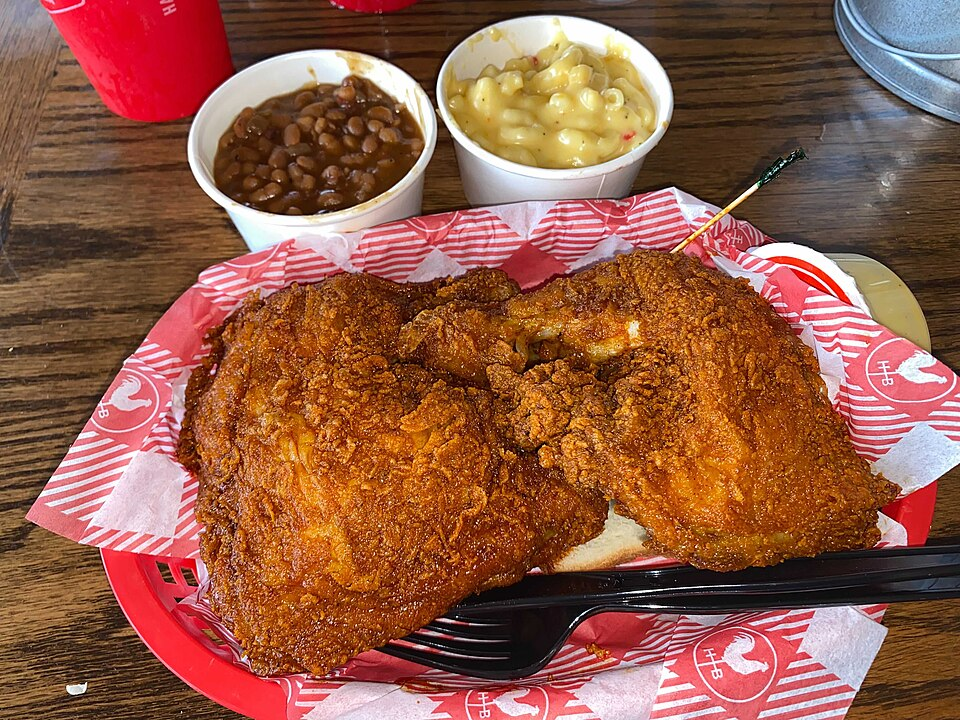
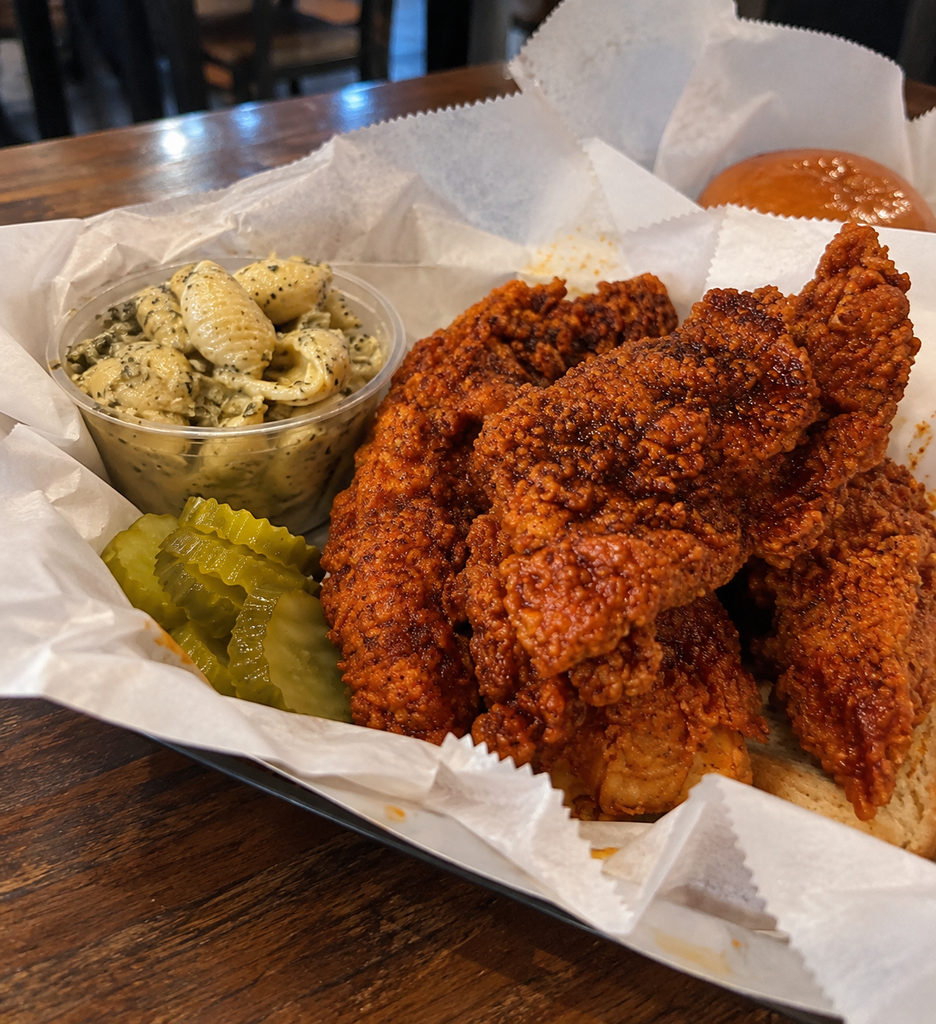
Hattie B’s menu includes leg-and-thigh quarters, breast-and-wing quarters, wings, half birds, sandwiches, and tenders. Then the side menu starts getting interesting: Southern greens, black-eyed pea salad, bacon cheddar grits, baked beans, red-skin potato salad, creamy slaw, and pimento mac and cheese.
Now compare two meals.
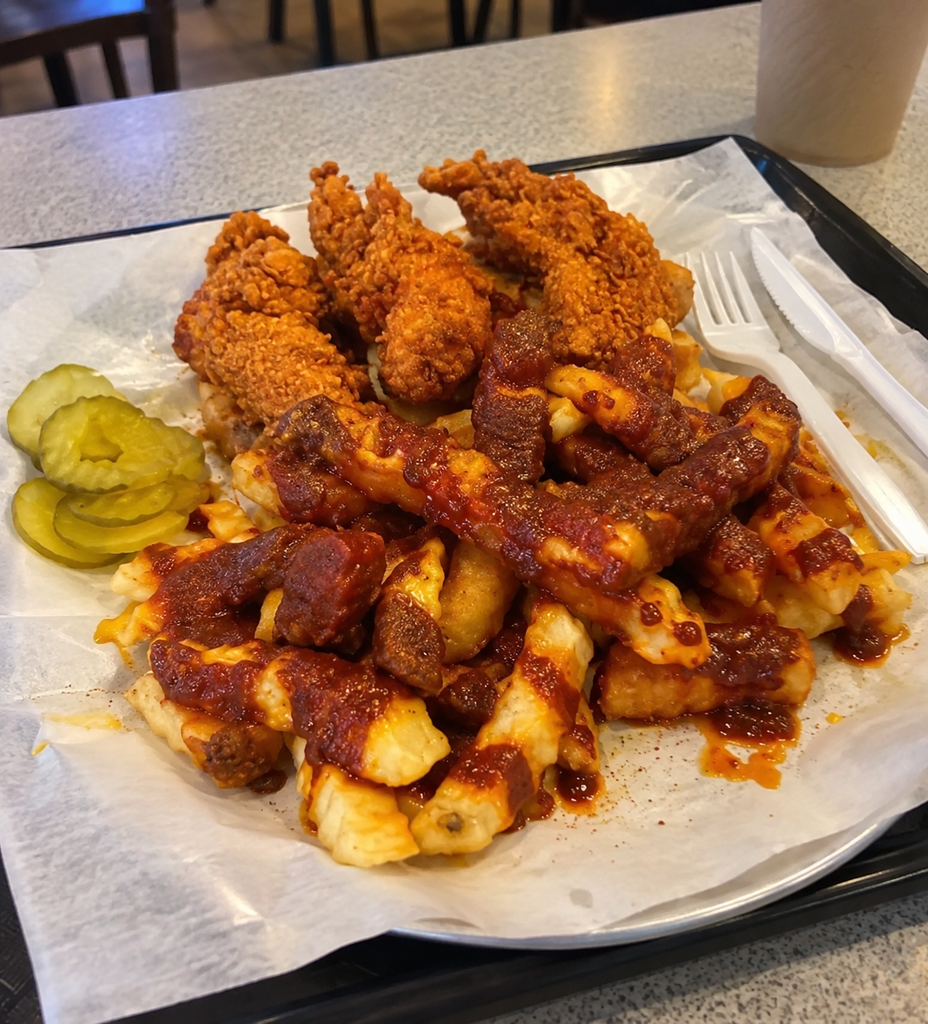
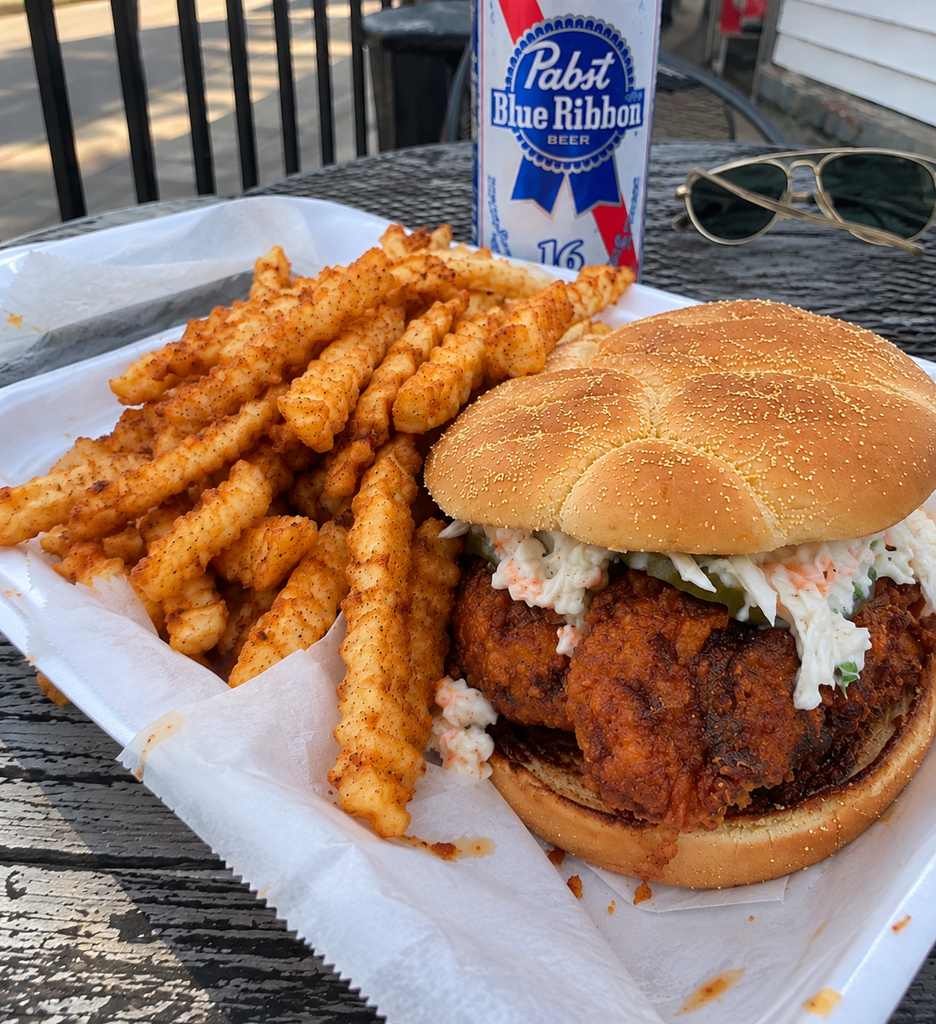
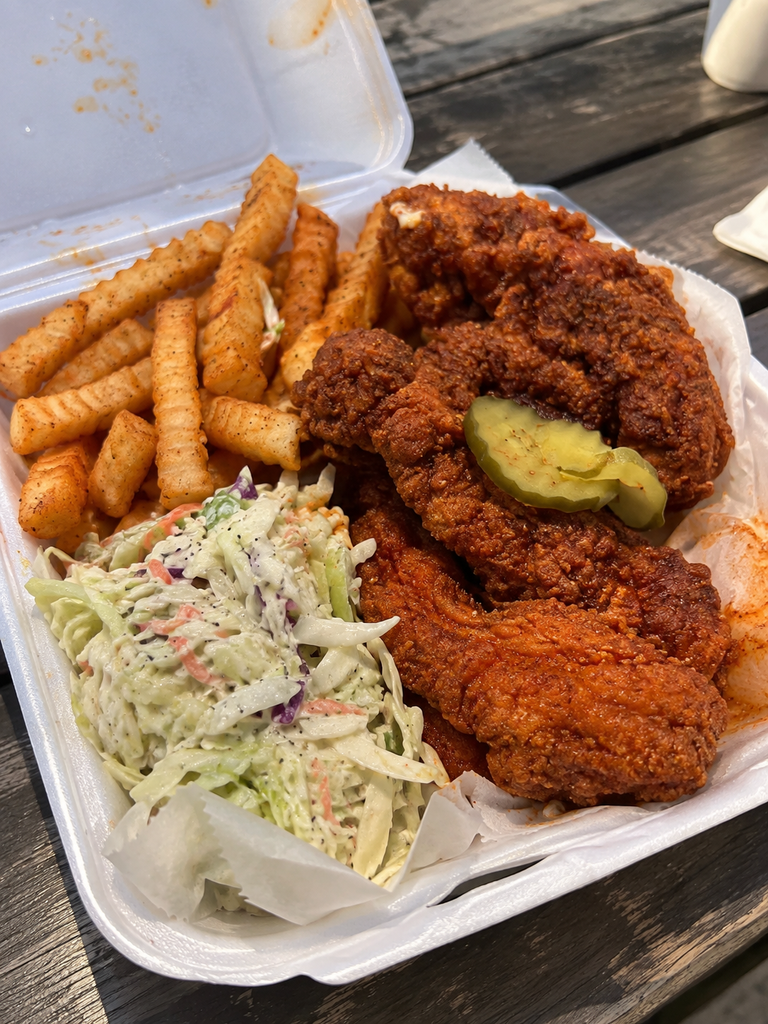
One is a blazing-hot sandwich with fries.
The other is dark meat with greens and black-eyed pea salad.
They come from the same restaurant, but they tell completely different stories.
The second tray looks less like a fast-food challenge and more like a Southern lunch plate.
Here’s what catches people off guard.
Hattie B’s black-eyed pea salad and bacon cheddar grits can tell you as much about the restaurant as its famous chicken sandwich.
The black-eyed pea salad is especially easy to overlook when pimento mac and cheese is sitting nearby demanding attention. Yet it provides exactly the kind of contrast heavily seasoned fried chicken needs. National Geographic has previously singled out both the black-eyed pea salad and pimento mac as notable accompaniments.
The insider move is simple: build a plate rather than a stunt.
Pick the chicken cut you actually want. Pick a heat level you can finish. Then use the sides to create contrast.
The trap is ordering fries automatically because that’s what normally comes beside a chicken sandwich.
In Nashville, the side board deserves a second look.
But some newer Nashville cooks have taken that idea much further. The next local order puts hot chicken inside something that looks like it wandered over from a completely different restaurant.
The Hot-Chicken Order Wrapped Around Mac, Bacon, Pickles, and Local Obsession
Red’s 615 Kitchen shows what happened once Nashville stopped treating hot chicken like a museum piece.
Its menu has included a Hot Chicken Mac and Cheese Crunchwrap built with hot chicken, pimento mac and cheese, bacon, pickles, comeback sauce, and a toasted tortilla. Red’s has also offered chicken and waffles, a hot-chicken mac-and-cheese bowl, catfish, pimento mac, and mustard potato salad.
Yes, the Crunchwrap sounds excessive.
That’s part of the charm.
You bite through the toasted exterior and hit crisp chicken, creamy mac, salty bacon, tart pickle, and sauce all at once.
It is messy in exactly the way Nashville’s older hot-chicken plates are messy, only the architecture has changed.
Instead of seasoned oil soaking downward into white bread, everything has been folded inward.
Here’s what catches people off guard.
One of modern Nashville’s insider hot-chicken orders comes wrapped in a tortilla.
Local online discussions have repeatedly praised Red’s, with the Crunchwrap earning particular attention among Nashville diners.
But there is another smart move here that is much less flashy.
Order boneless thigh.
Most visitors equate “boneless chicken” with tenders. Red’s has offered boneless thigh options, giving you the convenience of boneless chicken while keeping the richness of dark meat.
Pair that with mustard potato salad and you’ve got a completely different meal from the standard tourist sandwich-and-fries combination.
The trap is believing “local” always means “old.”
It doesn’t.
Nashville food culture keeps moving, borrowing, folding, frying, and making new traditions.
And one longtime hot-chicken shop takes that freedom to a place involving fried grilled cheese and apples.
The Order That Sounds Wrong Until Sweet Apples Hit Hot Chicken
Pepperfire was established in 2010 and describes its approach as both traditional and experimental. That philosophy becomes obvious when you reach the Tender Royale.
This is not a modest plate.
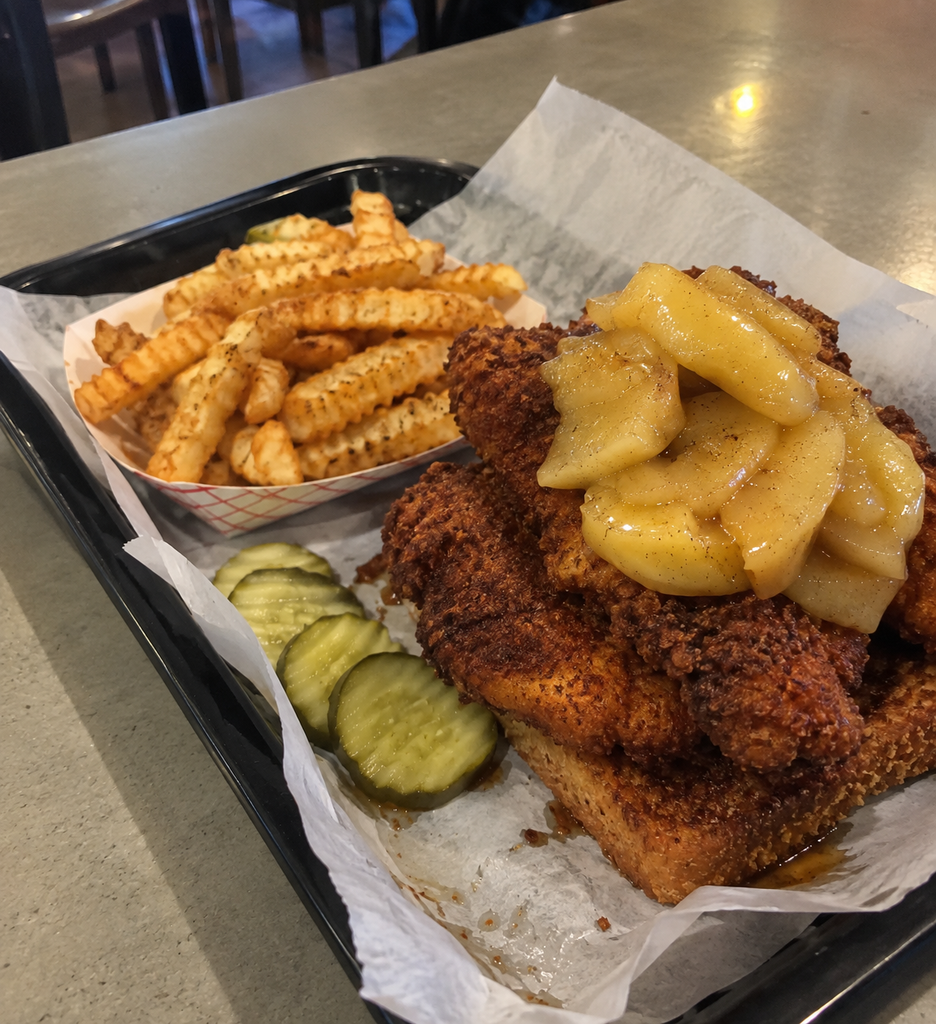
The Tender Royale combines a deep-fried pepper-jack grilled cheese sandwich with three hot-chicken tenders.
Then there is the AppleJack.
It takes that already outrageous combination and adds sweet baked apples.
Hot chicken. Fried grilled cheese. Pepper jack. Apples.
On paper, it sounds like somebody lost a bet.
On the plate, the logic starts making more sense. Hot chicken loves contrast. Rich fried food wants sweetness and acidity nearby. Nashville has been balancing fiery chicken with pickles, slaw, beans, and sweet elements for generations.
Pepperfire simply pushes the idea farther.
Here’s what catches people off guard.
The AppleJack turns sweet baked apples into part of the hot-chicken experience instead of treating sweetness as dessert.
The insider move is to stop judging Pepperfire by what a Nashville hot-chicken plate is “supposed” to look like.
This is a restaurant that helped participate in the dish’s modern evolution, and its side menu has reflected that experimental streak too.
Green-chile mac and cheese, fried okra, cinnamon apples, collard greens, red potato salad, poppyseed slaw, and baked beans have all appeared among its current offerings.
The trap is ordering fries without reading the rest of the menu.
Hot-chicken restaurants can double as a crash course in Southern sides, and Pepperfire gives you plenty to work with.
But before chasing the strangest thing on any menu, there is one old Nashville lesson worth learning.
Sometimes the smartest word you can say at the counter is “Mild.”
The Heat Level That Sounds Timid Until You Eat at Bolton’s
Nashville does not have a universal hot-chicken heat scale.
That’s one of the most useful things to know before ordering.
Bolton’s, Prince’s, Hattie B’s, 400 Degrees, and newer operators use different systems. One shop’s Medium cannot safely be translated into another shop’s Medium.
This is where visitors get themselves into trouble.
They arrive after eating “Hot” somewhere else, scan the menu, and assume they have established their credentials.
Then the chicken arrives.
The first bite is manageable.
The second starts building.
By the third, the seasoning has found every corner of your mouth, your drink suddenly seems much smaller than it did five minutes ago, and that innocent-looking potato salad becomes the most important object on the table.
Here’s what catches people off guard.
At certain Nashville restaurants, ordering Mild can be evidence that you know exactly what you’re doing.
Bolton’s specifically warns customers that its Mild still packs heat, and local diner discussions have long treated its scale with respect.
The insider tip is to learn each restaurant independently.
Don’t order based on pride. Order based on flavor.
That also means you don’t need to make every part of the meal spicy. A cool or rich side such as potato salad, slaw, greens, grits, beans, or mac and cheese gives your palate somewhere else to go.
The trap is turning lunch into an endurance contest.
Hot chicken should taste like fried chicken, seasoning, spice, fat, salt, and whatever makes that particular restaurant distinctive.
If all you remember is pain, you missed half the meal.
And speaking of things visitors miss, look underneath the chicken before somebody clears your tray.
The Cheapest Piece of the Meal Might Hold the Best Last Bite
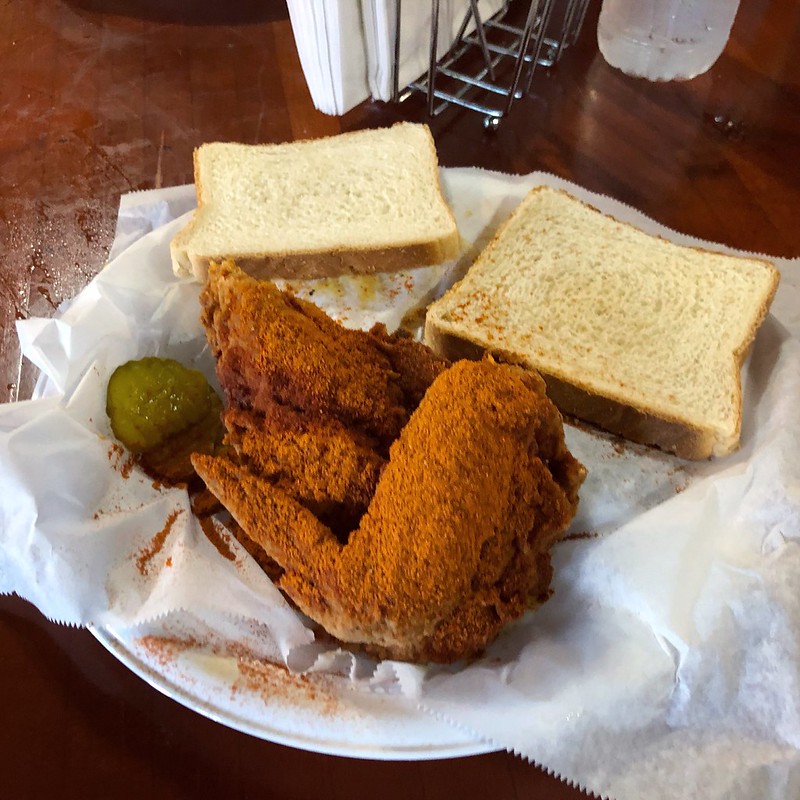
Traditional Nashville hot chicken arrives on plain white bread with pickles.
Not brioche.
Not a toasted artisan bun.
Plain white bread.
That bread has a job.
As the chicken rests, seasoned oil and drippings move downward. The slice underneath catches them. What began as pale, soft sandwich bread becomes stained with spice and chicken juices.
By the time you’ve worked through a leg quarter, the bread underneath may look like the least photogenic thing on the plate.
Eat it anyway.
It has been sitting beneath the chicken collecting everything that escaped.
Here’s what catches people off guard.
The grease-soaked white bread under traditional hot chicken can become one of the most intensely seasoned bites on the entire plate.
The insider move is not to pull it out and discard it when the food arrives.
Give it time.
The pickles matter for the opposite reason. Where the bread absorbs richness, pickles interrupt it. Their acidity and crunch cut across the fried crust and seasoned fat, which is why they belong on the plate rather than sitting there as decoration.
Extra bread and pickles are not admissions of defeat.
They’re tools.
The trap is treating the traditional presentation like disposable garnish while focusing only on the chicken.
That would be like ordering barbecue and ignoring what the smoke did to the bark.
But the bread-and-pickle ritual also points toward something bigger, because Nashville hot chicken did not begin as a tourism product.
Its story belongs to a much older Nashville.
The Nashville Food Story That Existed Long Before Broadway Started Selling It
Hot chicken’s roots run through Black Nashville, not the modern tourism machine.
Research on the dish traces it through Nashville’s Black neighborhoods and businesses for decades before it became a nationally recognized symbol of the city. The Tennessee State Museum connects that history with Black entrepreneurship as well as segregation, redlining, urban renewal, and neighborhood displacement.
That history changes the way the old-school plate looks.
The plain bread does not seem cheap.
The no-frills presentation does not seem unfinished.
The neighborhood chicken shack stops looking like an early version of a modern fast-casual restaurant and starts looking like what it actually was: part of a community food tradition that existed long before visitors arrived with weekend itineraries.
Prince’s sits at the center of that story.
According to Prince family legend, Thornton Prince’s taste for hot chicken began after a woman attempted to punish his wandering ways by loading his fried chicken with pepper. Instead of suffering, Prince supposedly loved it.
It’s one of Nashville’s great food stories.
It should also be treated as legend rather than courtroom evidence. Reporting on the Prince family has noted that the exact details cannot be firmly documented.
Here’s what catches people off guard.
For roughly seven decades, Nashville hot chicken was primarily associated with Black Nashville before becoming the tourism phenomenon visitors recognize today.
The insider tip here isn’t about parking or spice levels.
It’s about context.
If you’re eating the dish because Nashville told you it is famous, know whose tradition made it famous.
The trap is treating hot chicken as if somebody invented it for a Broadway bachelor-party weekend.
They didn’t.
And after that history, it is worth seeing what the next generation is doing with the food right now.
The New-School Truck Proving There Is No Single “Local” Order
Brave Idiot represents another side of Nashville hot chicken.
Instead of pretending the dish stopped evolving once somebody put chicken on white bread, the food truck has become known locally for creative specials alongside its hot-chicken staples. Eater has included it in Nashville hot-chicken coverage, while local Reddit discussions repeatedly put it among the city’s standouts.
That matters because “eat like a local” can become its own kind of cliché.
Sometimes people imagine a local order has to be the oldest thing available.
Nashville doesn’t work that way.
A longtime institution can be local.
So can a food truck serving a ridiculous special that did not exist ten years ago.
Brave Idiot has developed a following around hot-chicken sandwiches and changing creations, with local discussions documenting everything from loaded fries to periodic breakfast burritos.
Here’s what catches people off guard.
The Nashville hot-chicken order locals are excited about today may be a weekly special that would have looked completely foreign to the city’s earliest hot-chicken cooks.
The insider move is to check what is actually being served rather than arriving determined to recreate somebody else’s “perfect” order.
Try the restaurant in front of you.
The trap is confusing authenticity with stagnation.
Prince’s leg quarter and a new-school hot-chicken special can both belong to Nashville. One shows where the tradition came from. The other shows that people here are still playing with it.
That is healthier for a food culture than freezing it in time for tourists.
Still, when you want the old-school feeling again, there is one simple side-dish decision that changes the whole tray.
The Side-Dish Swap That Turns Fast Food Back Into a Southern Lunch
Fries are easy.
They’re familiar, salty, crisp, and almost impossible to argue with.
They’re also one of the easiest ways to miss what Nashville’s hot-chicken restaurants do beyond chicken.
Prince’s offers sides such as greens, baked beans, potato salad, slaw, and mac and cheese. Hattie B’s expands the field with black-eyed pea salad and bacon cheddar grits. Bolton’s has offered string beans, potato salad, and baked beans. Pepperfire brings in fried okra, collards, cinnamon apples, and green-chile mac. Red’s has pimento mac and mustard potato salad.
Read that list again.
That is not the side menu of a generic chicken chain.
It looks more like several Southern lunch counters got together and started arguing over whose grandmother had the better plate.
Greens bring bitterness and savory depth.
Potato salad gives you something cool and soft against the crust.
Beans bring sweetness and weight.
Grits are creamy and comforting.
Slaw snaps.
Here’s what catches people off guard.
Skipping fries may be the easiest way to make your hot-chicken lunch taste more like Tennessee and less like a generic chicken combo.
The insider move is to use the side dish as contrast.
If the chicken is fiery and rich, don’t automatically add another pile of fried food. Give your mouth a different temperature, texture, or flavor.
The trap is treating sides as filler.
At the better hot-chicken joints, they’re part of how the meal works.
And there is one more dark-meat trick that gives you the convenience tourists want without giving up the part regulars love.
The Boneless Order That Is Better Than Reaching for Tenders
Boneless does not have to mean chicken breast.
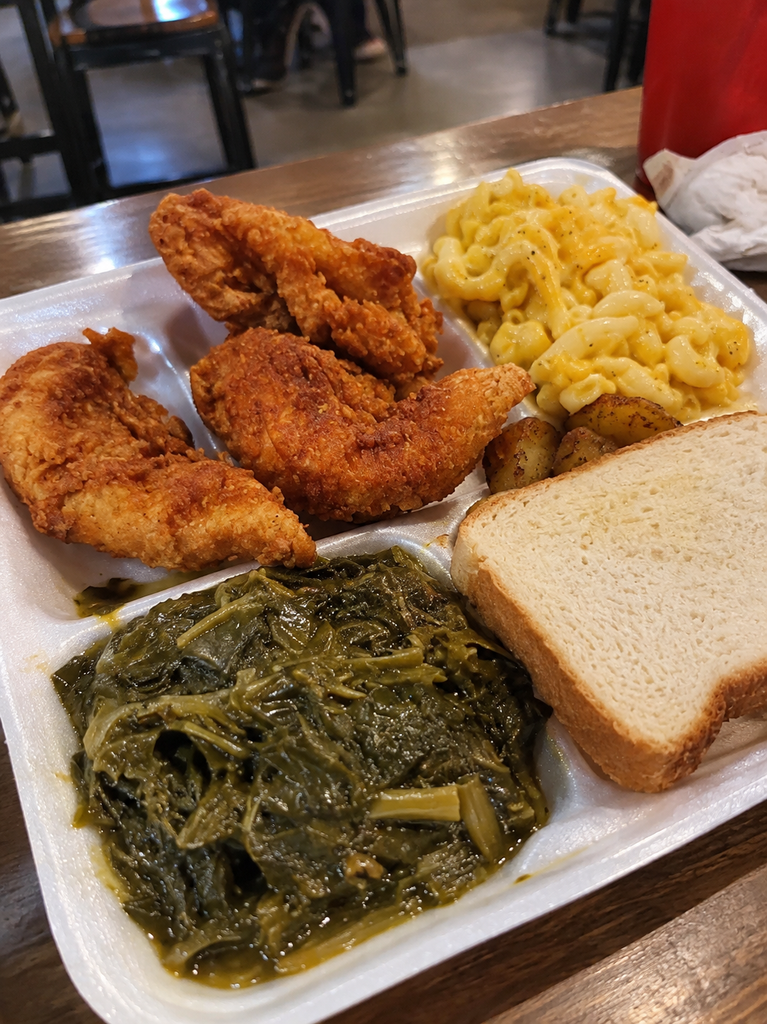
Red’s 615 has offered boneless thigh in its Snack Box, and delivery ordering has also shown boneless thighs with two sides among frequently ordered dishes.
That is such a simple idea that it is easy to miss.
Tenders dominate modern chicken menus because they’re convenient. No bones. No knife. No wrestling with a leg quarter while seasoned oil works its way onto your fingers.
But thigh meat brings something tenders often can’t.
Richness.
A boneless thigh gives you the practical advantage of a tender while keeping the darker, juicier character that makes leg-and-thigh quarters so satisfying.
Cut through it and the crust gives way to meat that feels substantial rather than merely convenient.
Here’s what catches people off guard.
The smartest boneless hot-chicken order may be thigh meat, not tenders.
Pair it with mustard potato salad or another contrasting side and you’ve built a plate without dealing with bones at all.
This is especially useful for visitors who genuinely dislike bone-in chicken rather than simply ordering tenders out of habit.
The trap is believing there are only two choices: traditional bone-in chicken or tourist-friendly tenders.
Modern Nashville menus have filled the space between them.
And for the strongest second-to-last stop, go back to the place that best proves hot chicken’s supporting cast can steal the show.
The Bolton’s Sandwich That Quietly Tells a Second Nashville Food Story
Bolton’s hot-fish sandwich deserves another look because it isn’t simply chicken seasoning applied to a different protein.
It belongs to a Nashville hot-fish tradition of its own.
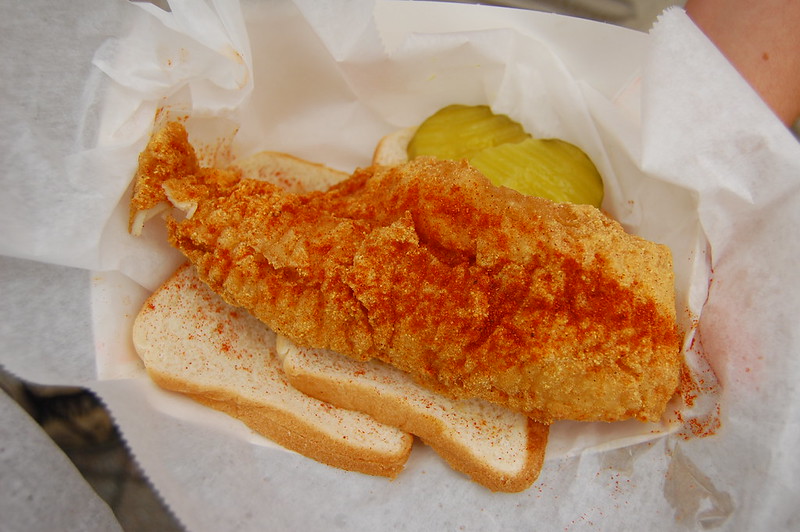
Historical Nashville Scene coverage described versions built around fried fish, hot seasoning or sauce, mustard, onions, pickles, and plain white bread. Bolton’s version has been associated with long whiting fillets and its assertive seasoning.
Nothing about it needs to be tall.
Nothing needs to drip with three sauces.
The fish itself is delicate. The coating carries the heat. Mustard flashes through the richness, onion gives you a raw snap, and the bread tries to hold the whole thing together.
This is the kind of food that can disappear from a visitor’s radar simply because one word dominates Nashville food marketing.
Chicken.
Here’s what catches people off guard.
Nashville’s spicy fried-food tradition has a fish chapter that many visitors never realize they skipped.
The insider move is to treat Bolton’s as a chicken-and-fish restaurant from the moment you walk in, because that is exactly what it calls itself.
If you’ve already eaten hot chicken elsewhere, the fish is not settling for your second choice.
It is the reason to go.
The trap is building a Nashville food itinerary around repeating the same sandwich at five different restaurants.
Do that and you’ll learn which sandwich you prefer.
Order across the menus and you’ll learn something about Nashville.
Which brings us to the strangest twist in the whole story.
The thing locals once knew that outsiders didn’t was not a particular order.
It was hot chicken itself.
The Unexpected Fact About Nashville Hot Chicken
For much of its history, knowing about Nashville hot chicken was itself insider knowledge.
The dish grew out of Black Nashville and remained closely associated with those communities for decades. The Tennessee State Museum has noted that Prince’s remained something of an insider Nashville institution before hot chicken’s modern rise, while the Music City Hot Chicken Festival helped push the dish and André Prince Jeffries into broader public attention in the 2000s.
Now the situation has flipped.
Visitors arrive already knowing they’re supposed to eat hot chicken. The insider knowledge is subtler: order the dark meat, respect each restaurant’s heat scale, notice the fish, read the side menu, save the bread, and don’t assume the hottest thing is the best thing.
That’s the real difference between eating hot chicken as an attraction and eating it as Nashville food.
The secret is no longer finding the hot chicken. It’s knowing what to do when the plate hits the table.