
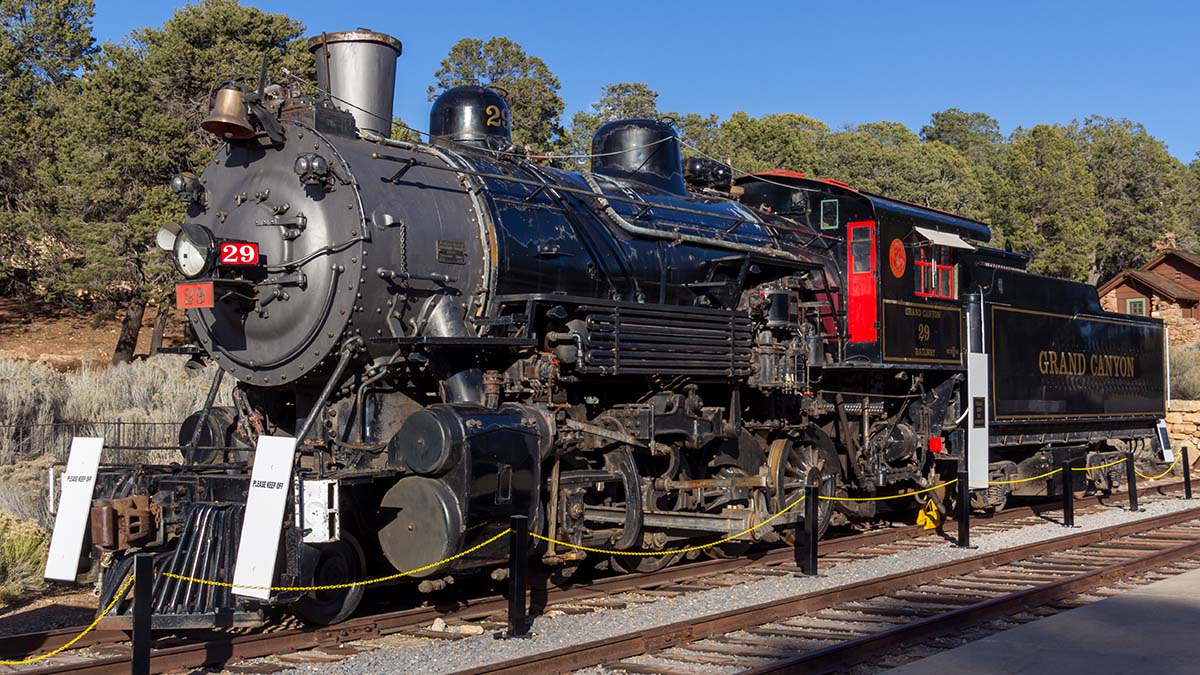
The Grand Canyon Railway spends more time getting you to the canyon and back than it gives you there.
On the regular same-day trip from Williams, Arizona, passengers spend 4½ hours aboard the train and get 3 hours 45 minutes between arrival and departure at Grand Canyon Depot.
That can make a memorable day. Vintage cars, roaming musicians and staged bandit encounters turn the journey into part of the attraction.
But if you picture a full day wandering between canyon overlooks, the timetable deserves a closer look.
Driving from Williams gives you more control over your visit. It also puts entrance queues, parking and the drive home on your shoulders.
The better choice comes down to one question: Is the train part of the experience you want, or mainly a way to reach the canyon?
The Train Takes You to the Canyon, Not Along Its Edge
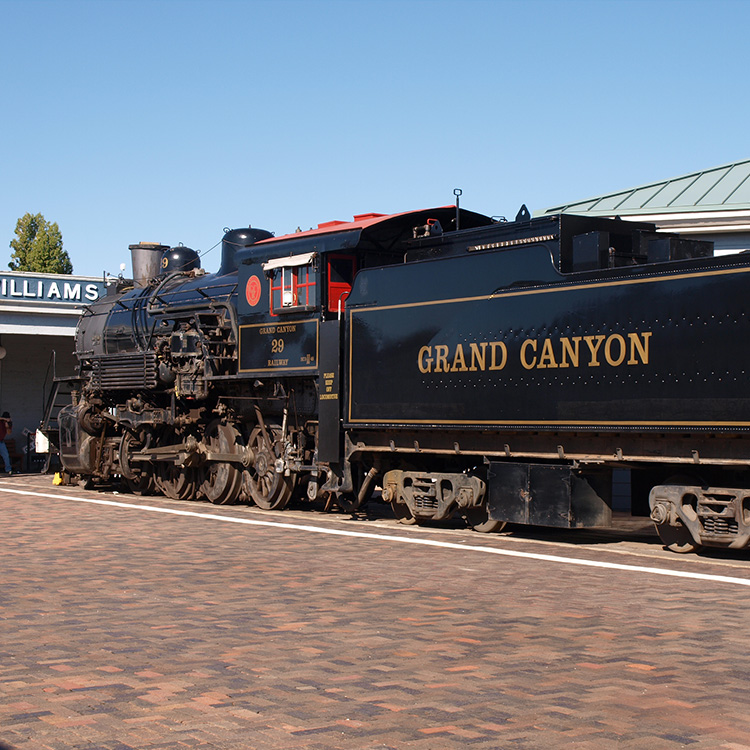
Grand Canyon Railway travels approximately 65 miles each way between Williams and the South Rim’s Historic Village.
The route crosses high desert, prairie and pine forest. It does not follow the canyon rim.
That distinction matters if you are considering an upgraded seat for canyon views through the window. The railway delivers you to those views; you get off the train to enjoy them.
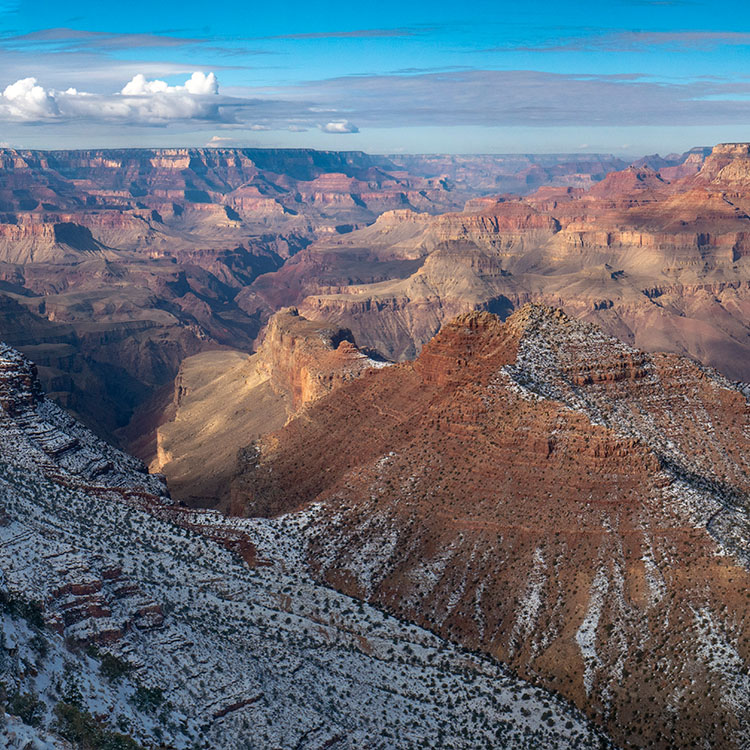
The arrival point is convenient. Grand Canyon Depot sits near El Tovar Hotel, approximately 200 yards from the canyon edge, according to the railway’s fact sheet.
This is a South Rim excursion. It does not serve the North Rim or Grand Canyon West.
Regular trains use diesel locomotives. Steam runs on selected dates, so check the departure before booking if a steam engine is the main attraction for your group.
For travelers considering a longer Arizona vacation, our guide to the six-day trip combining Grand Canyon Railway and Verde Canyon Railroad explains how those two railway experiences fit into one itinerary.
Almost Four Hours at the Canyon Comes With a Catch
The railway’s published timetable lists two seasonal schedules:
| Regular service | Leave Williams | Arrive at canyon | Leave canyon | Return to Williams |
|---|---|---|---|---|
| January–October | 9:30 a.m. | 11:45 a.m. | 3:30 p.m. | 5:45 p.m. |
| November–December, excluding December 25 | 8:30 a.m. | 10:45 a.m. | 2:30 p.m. | 4:45 p.m. |
All times are Arizona Mountain Standard Time.
The winter schedule starts earlier, but the canyon stop stays the same: 3 hours 45 minutes.
That is the gap between trains, rather than uninterrupted time at an overlook.
The railway’s current reservation policies say boarding begins approximately 15 minutes before departure. Getting off the train, walking uphill toward the rim, eating lunch and making restroom stops all take another slice.
For a practical planning example, start with the scheduled 225 minutes. Set aside:
- 15 minutes for return boarding.
- 20–30 minutes total for leaving the train, reaching the rim and returning.
- 30–45 minutes for lunch and restroom stops.
That leaves roughly 2 hours 15 minutes to 2 hours 40 minutes for views, walking and other activities.
These are planning allowances, not a promised itinerary. Your pace and any queues will change the result. Follow the departure and return instructions provided for your trip.
The day also starts before the train moves. Allow at least one hour before departure for ticket pickup, as the reservation policies advise. The booking terms require pickup at least 30 minutes before departure; that is the minimum deadline, rather than the arrival time to plan around.
Give the Train Layover One Clear Priority
For a first visit by rail, the Historic Village and a manageable stretch of the Rim Trail make a sensible pairing.
Reach the rim first. Then decide how much walking, shopping or exploring nearby historic buildings fits your remaining time.
The Trail of Time adds geological context through rock samples and timeline markers. The paved section between the Historic Village and Yavapai Geology Museum is approximately 1.3 miles one way.
Walking the full section out and back means about 2.6 miles. Choose a turnaround point that leaves a comfortable margin for returning to the depot.
An organized rim tour is another option, but it uses the same layover. The railway offers motorcoach tours tailored to the train schedule. Confirm the itinerary, meal arrangements and price before booking.
Driving Can Give You More Canyon Time
From Williams, the direct route follows Arizona State Route 64 north through Tusayan and the South Entrance.
The National Park Service gives approximately 60 minutes to the entrance. That does not mean you will be standing at an overlook in an hour.
The Visitor Center is another 4.9 miles beyond the entrance station. You still need to get through the gate, find parking and walk.
In light traffic, 75–90 minutes from Williams to being parked and ready to walk is a reasonable planning allowance. It is an estimate, not a guaranteed travel time.
Using the train’s 8-hour-15-minute departure-to-return window gives this comparison:
| Within the same length of day | Train | Driving estimate |
|---|---|---|
| Travel and arrival allowance | 4 hr 30 min | 2 hr 30 min–3 hr |
| Time available at the canyon | 3 hr 45 min | 5 hr 15 min–5 hr 45 min |
For this example, driving allows 75–90 minutes each way, including an allowance for arrival and departure tasks. Time at the canyon includes meals, walking and other activities. The train’s scheduled stop also includes return boarding.
Under those assumptions, driving could provide another 1½–2 hours at the destination, provided traffic and parking cooperate.
Traffic can erase that advantage. NPS warns that South Entrance waits can reach two hours during busy spring-break and summer periods.
A Car Gives You Options, but Parking Still Matters
The Visitor Center has four parking areas and a short walk to Mather Point. During the busy season, NPS says visitors arriving by 10 a.m. can usually find parking.
If your priority is the Historic Village, Bright Angel Trailhead or the Hermit Road shuttle, NPS identifies Lot D as a useful parking choice.
Driving also opens up Desert View Drive, a 23-mile scenic road with eastern viewpoints.
Allow approximately 40 minutes of driving one way before stops. An out-and-back adds about 46 miles and 80 minutes behind the wheel, plus sightseeing.
A car does not reach every overlook. Hermit Road is closed to ordinary private vehicles March 1–November 30. From December through February, vehicles under 22 feet may use it, weather permitting; the Hermit Road shuttle does not operate during those winter months. nps.gov
Yaki Point is reached by shuttle, bicycle or foot. Check the current South Rim shuttle routes and operating hours before planning your stops.
Compare the Full Cost Before Choosing a Seat
Use the railway’s booking system to price a round trip for your dates and preferred classes. Keep train fares, taxes and park admission separate when comparing that total with driving.
Park admission is charged with railway reservations unless covered by an eligible pass. The operator lists $20 for one adult or $35 total for a reservation with two to nine adults, before applicable nonresident charges. Parking in Williams is complimentary.
Driving carries a standard $35 private-vehicle entrance fee, valid for seven days, before applicable nonresident charges.
For a transparent fuel example, a 126-mile round trip at 25 mpg uses about five gallons. At a hypothetical $4 per gallon, that is approximately $20 in fuel. Rental charges, insurance and additional scenic driving are separate.
NPS also lists a $100 additional admission charge for each non-U.S.-resident visitor age 16 or older, unless admitted with an eligible annual or America the Beautiful pass. That applies whether you arrive by train or car.
A more expensive train seat changes the ride. It does not buy more time at the canyon.
If the railway experience is the main draw and you would prefer an outing closer to home, our comparison of seven Tennessee train rides by price offers other options.
Match the Trip to Your Walking and Mobility Needs
The railway identifies Coach and First Class as its accessible classes, with boarding lifts, wheelchair or scooter spaces and accessible restrooms.
Its limits include a scooter size of 26 by 50 inches and a boarding-lift load of 500 pounds total. Dome seating requires stairs, and the railway does not provide wheelchairs.
Arrange assistance through a live reservations agent at 800-843-8724.
Park shuttles are wheelchair accessible, but NPS lists a maximum wheelchair size of 30 by 48 inches and warns that most motorized scooters will not fit.
Qualifying visitors with mobility limitations can obtain a Scenic Drive Accessibility Permit for certain restricted roads. It does not replace the state-issued placard needed for accessible parking spaces. nps.gov
Check the route between the depot or parking area and the rim as well as the transport itself.
Check Dining, Lodging and Weather Before Departure
As of November 13, 2026, lodging operator Xanterra’s October 28 alert lists El Tovar, Bright Angel, Kachina, Thunderbird and Maswik lodges as closed through November 19, with a planned November 20 reopening following damage to water infrastructure. Confirm accommodation before booking an overnight train package. www.grandcanyonlodges.com
Day visits remain possible, but dining is limited. The operator lists Harvey House Café lunch service from 11 a.m. to 3:30 p.m., alongside other reduced offerings. Check the alert before relying on a particular restaurant, and carry food and drinking water. www.grandcanyonlodges.com
The South Rim sits approximately 7,000 feet above sea level. Winter snow, ice and road closures—and summer thunderstorms—can affect either trip. Review park conditions before setting out.
Choose the train when the railway experience is a priority. Driving generally offers greater flexibility and potentially more canyon time, depending on traffic and parking.
If sunrise or sunset at the rim is the priority, driving lets you plan around it. The regular same-day train arrives after sunrise and leaves before sunset.