
On Christmas night in 1961, flames tore through the Nashville hotel that gave Maxwell House coffee its name.
Dozens of guests and staff evacuated. Fire broke through the roof. Firefighters eventually turned their attention to protecting neighboring buildings.
The hotel was lost. Its name survived on coffee containers across America.
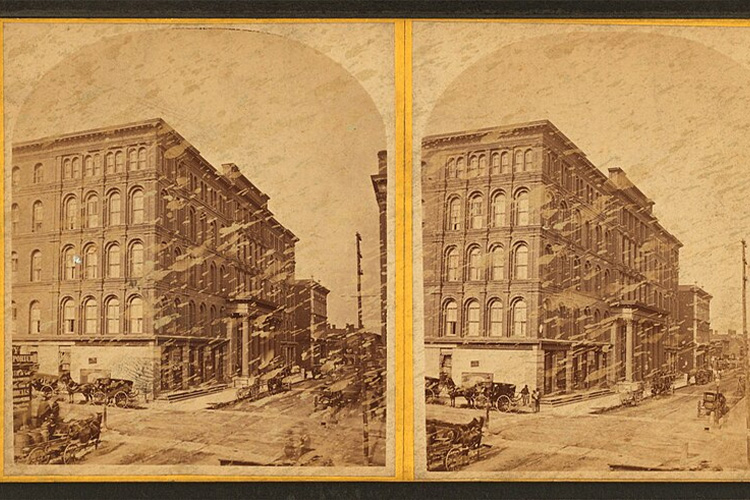
Long before that name reached grocery aisles, the building at Fourth Avenue and Church Street had served as a wartime prison hospital, welcomed presidents, and offered travelers a room and meals for $4 a day.
Its story stretches from an unfinished building during the Civil War to a dining room whose coffee became more famous than the hotel itself.
And while the original Maxwell House disappeared from Nashville’s streets, you can still trace how a family name became a hotel name—and then a household name.
Flames in a Fourth-Floor Corridor
Flames were first spotted in a fourth-floor corridor on December 25, 1961, according to the Tennessee State Library and Archives.
Within an hour, fire had spread to the third and fifth floors. It eventually broke through the roof.
Off-duty firefighters were summoned. A large crowd watched in roughly 30-degree weather as crews fought the Christmas-night blaze.
As the fire spread, protecting neighboring buildings became a priority. The hotel occupied a downtown corner, and the danger extended beyond the people and rooms inside it.
Early Associated Press coverage said everyone inside had escaped. A follow-up reported one man missing, and later historical coverage reported one death.
Those accounts reflect different stages of the reporting. The first evacuation reports were not the final word on the fire’s human cost.
The fire’s origin is unknown.
What remained of the hotel would have to come down. A 1962 demolition photograph in Nashville Public Library’s collection shows the aftermath. The library’s description says the gutted remains were razed for safety.
A bank later occupied the site.
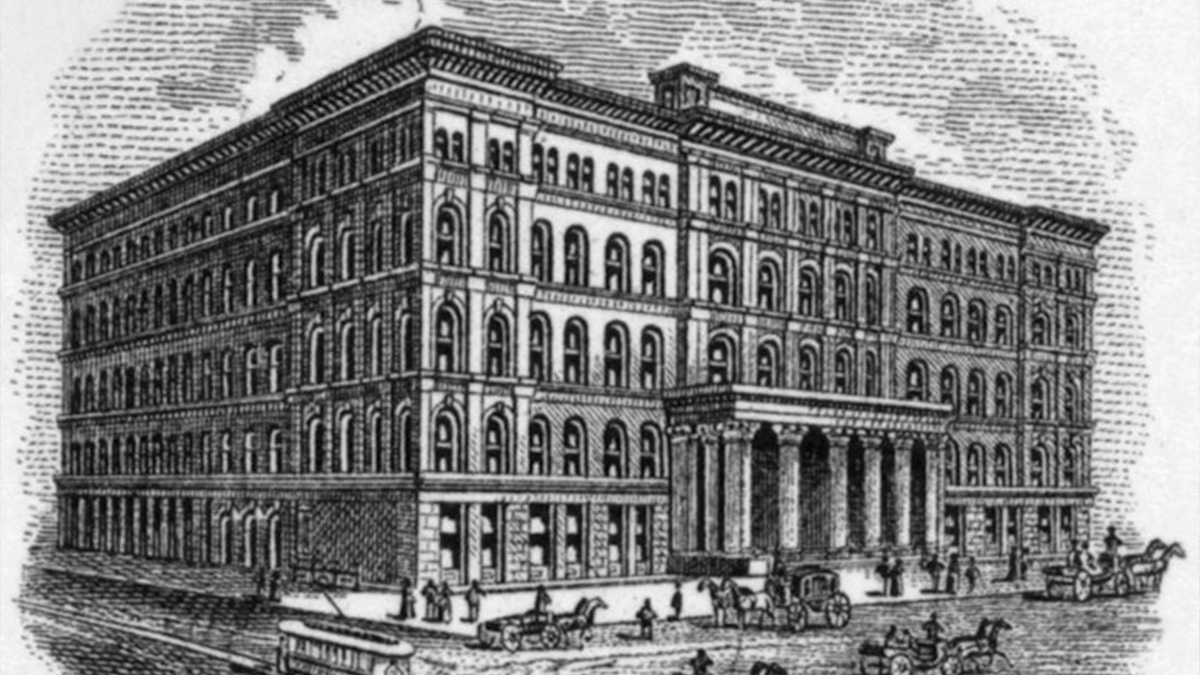
The building had stood for more than a century. For its first ten years, it had waited to become the hotel its developer imagined.
A Luxury Hotel With a Ten-Year Wait
Construction began in 1859. The Maxwell House Hotel did not formally open until fall 1869.
A war stood between those dates.
Colonel John Overton Jr. developed the hotel and named it for his wife, Harriet Maxwell Overton. Architect Isaiah Rogers designed the building, which was constructed using enslaved labor.
During the Civil War, the occupying Union army used the unfinished structure as barracks and a prison hospital.
Its first occupants arrived under circumstances far removed from a luxury stay. Before travelers could book rooms and sit down to dinner, the building had already become part of Nashville’s wartime history.
When the hotel finally opened, it offered five stories, 240 rooms, steam heating, gas lighting, and “a bath on every floor.”
That last detail gives a sense of how different hotel comforts looked in 1869. A bath on each floor was something to advertise.
The daily rate was $4, including meals, according to the Tennessee Encyclopedia.
That price covered more than somewhere to sleep. Dining was part of the stay, connecting the guest rooms upstairs with the meals—and eventually the coffee—served below.
Mirrors, chandeliers, elaborate woodwork, parlors, and dining rooms filled out the promise of an elegant Nashville hotel.
After a decade of construction and wartime use, the Maxwell House could finally welcome the guests it had been built to serve.
Two Entrances, Two Different Arrivals
The main entrance faced Fourth Avenue, beside a district known as the Men’s Quarter.
Saloons and gambling helped give the neighborhood its reputation. Women entered separately from Church Street, according to Nashville’s historical walking-tour brochure.
Even the doorway reflected the social rules of the time.
Two guests heading to the same hotel could approach from different streets because of those expectations. The address tells you where the building stood; the entrances tell you something about the city around it.
The hotel’s guests included nationally known figures. A Tennessee Historical Commission marker names seven presidents associated with it: Andrew Johnson, Rutherford B. Hayes, Grover Cleveland, Theodore Roosevelt, William McKinley, William Howard Taft, and Woodrow Wilson.
The names show how far the hotel’s reach extended beyond Nashville.
For a building that had spent its earliest years unfinished, it became a place connected with some of the country’s most recognizable public figures.
A Christmas Menu From Another Era
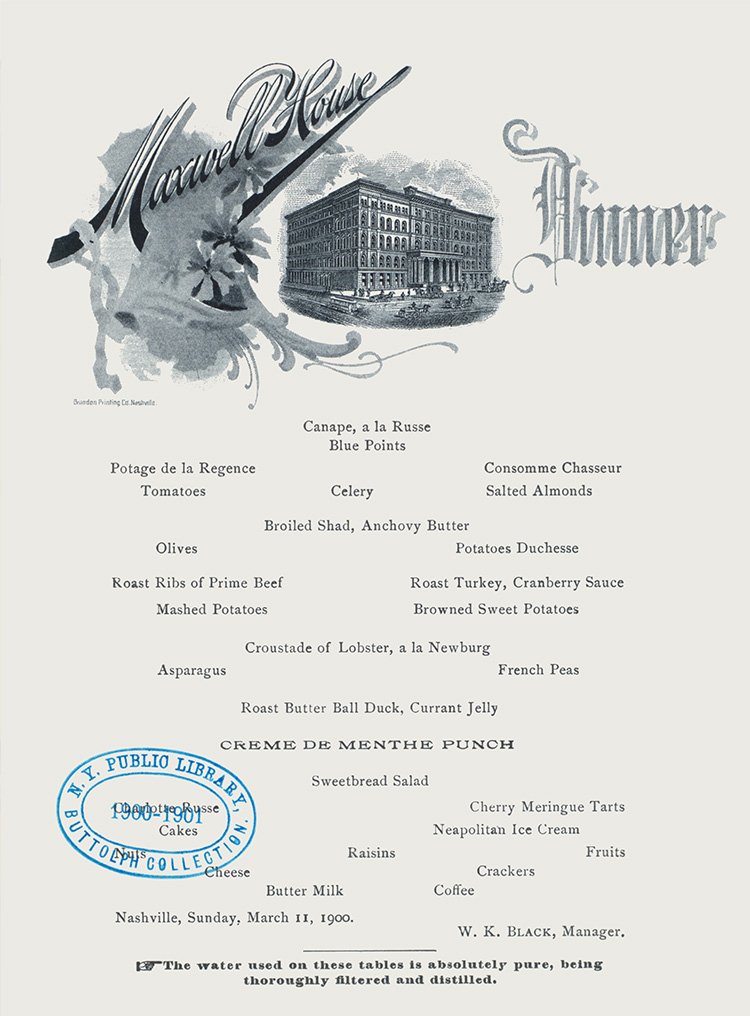
Decades before the fire, Christmas at the Maxwell House left another record: an 1879 holiday menu.
The Nashville Historical Foundation identifies prairie grouse, buffalo tongue, boar’s head, opossum, and raccoon among its offerings.
It is a very different lineup from the turkey, ham, and familiar sides many readers would expect at a holiday dinner today.
The surviving menu records the elaborate Christmas dinners that helped make the hotel famous.
It also preserves a more specific piece of the hotel’s life than a list of famous guests can provide: the food people could actually order and eat.
But the dining room’s most enduring connection would come from something much more familiar.
How the Hotel’s Name Reached the Coffee Aisle
Kraft Heinz dates the introduction of Joel Cheek’s coffee to 1892 and identifies the Maxwell House Hotel as its first major customer and namesake.
The hotel bought Cheek’s coffee for its dining room. The coffee carried the hotel’s name far beyond Fourth and Church.
A guest could encounter Maxwell House over breakfast in Nashville. Eventually, customers across the country could buy coffee bearing that same name.
The connection is easy to miss now. Someone reaching for Maxwell House in a grocery store does not need to know about Harriet Maxwell Overton, the hotel’s two entrances, or its long-delayed opening.
Yet all of those stories sit behind the name.
The Tennessee State Museum’s account traces the connection between the landmark and the brand.
For more Tennessee history, the museum also appears in our guide to free museums in Nashville.
By Christmas 1961, the coffee had carried the hotel’s name across the country for decades.
The fire could destroy the building. It could not erase a name that had already become familiar far beyond Nashville.
The Disputed Presidential Endorsement
The famous slogan came with a story of its own.
A longstanding account credits Theodore Roosevelt with saying “Good to the Last Drop” after drinking the coffee. Some versions place the remark at the hotel; another places it at Andrew Jackson’s Hermitage.
The story is disputed.
The Tennessee State Library and Archives calls it apocryphal. The Tennessee State Museum says Roosevelt most likely did not say it.
That distinction matters because the slogan story and the coffee’s Nashville origins are often told together. One is a disputed presidential anecdote. The other is the documented connection between a coffee business and an early hotel customer.
The hotel’s role in naming the coffee rests on firmer ground than the presidential endorsement.
What Remains at Fourth and Church
The original Maxwell House stood at the northeast corner of Fourth Avenue North and Church Street.
Today, the historical marker and old photographs help tell its story. The free Nashville Sites self-guided tour includes written and audio narration, along with images of the lost building. You can explore it downtown or remotely.
The photographs are especially useful at a place like this. With the hotel gone, they let you connect the present-day corner with the five-story building that once occupied it.
If you want to keep exploring the city’s past, our guide to Nashville buildings with stories most locals have never heard offers more places to look.
The modern Millennium Hotel Maxwell House Nashville, at 2025 Rosa L Parks Boulevard, is a separate building at a separate location. Built in 1979, it honors the earlier landmark.
For anyone following the original hotel’s history, Fourth and Church is the corner to remember.
The original hotel is gone. Its name still follows a remarkably personal path: from Harriet Maxwell Overton, to a Nashville hotel, to the coffee brand that outlived it.