
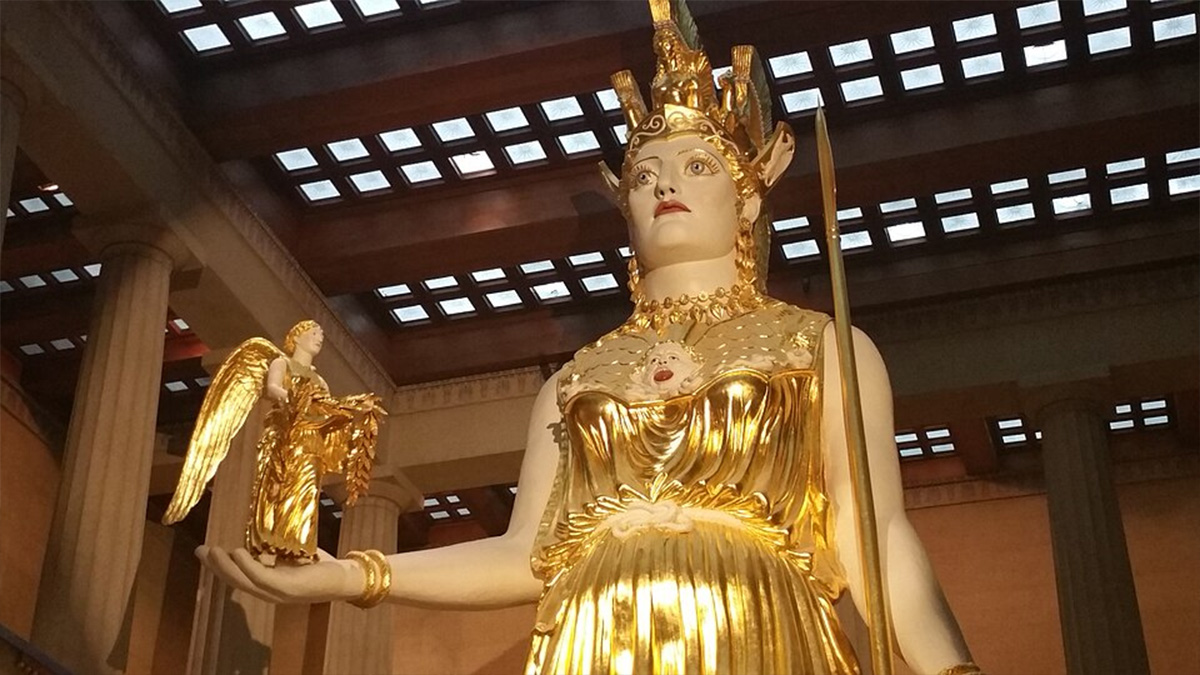
The winged figure in Athena’s right hand is 6 feet 4 inches tall.
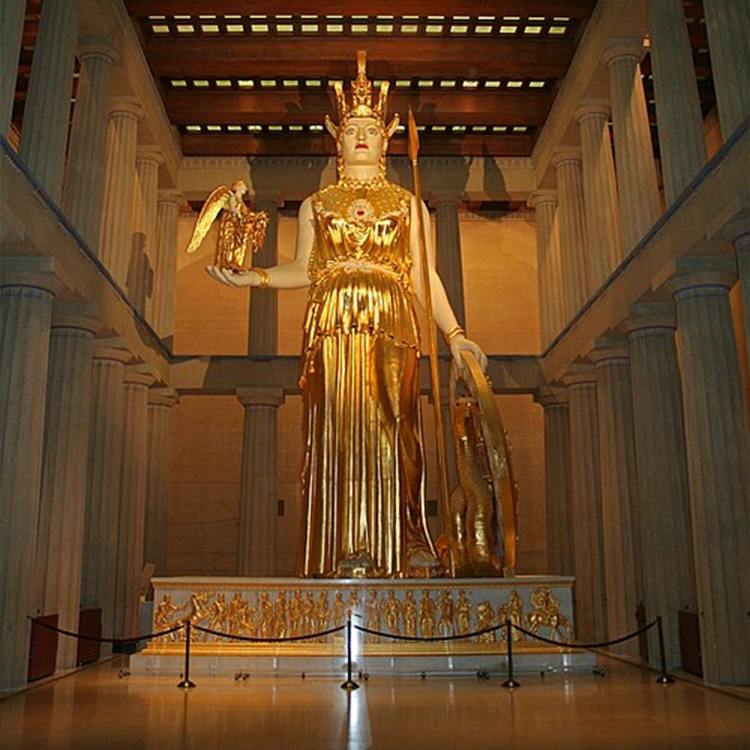
Inside Nashville’s Parthenon in Centennial Park, that figure—Nike, the Greek goddess of victory—rests in the palm of a statue standing 41 feet 10 inches tall.
Athena is so large that sculptor Alan LeQuire cast her in sections and assembled them inside the building. Her gold finish came later, after she had stood white for approximately 12 years.
The temple, the statue, and the gold were separate projects spread across more than a century. Nashville started with the building.
Nashville Built a Temple Before It Had a Goddess
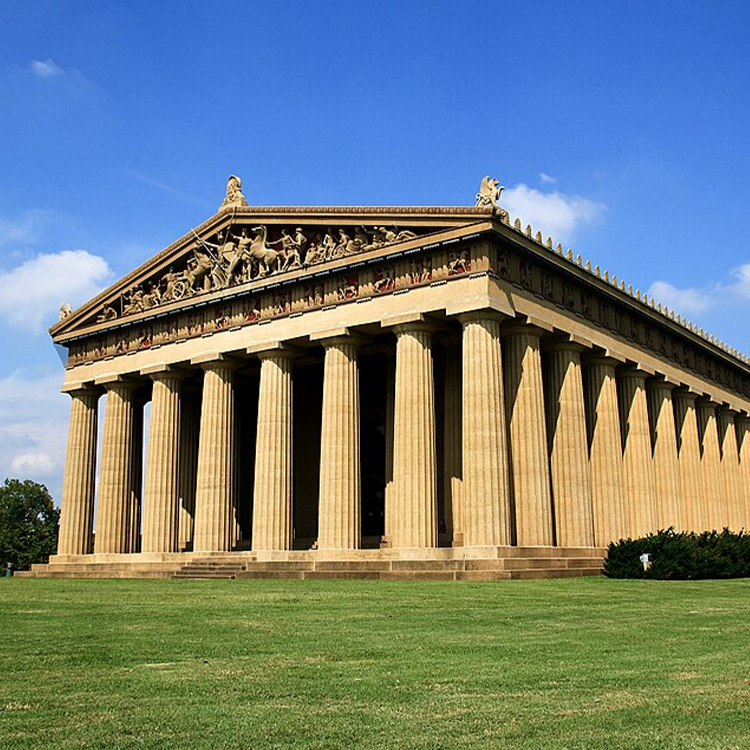
The first Nashville Parthenon opened in 1897 as the Fine Art Building for the Tennessee Centennial Exposition.
The Greek design suited a city already known as the “Athens of the South,” a nickname tied to Nashville’s educational and classical ambitions. But the exposition building was temporary, and it began to deteriorate.
In 1920, Nashville decided to rebuild it as a permanent structure.
Reconstruction ran from 1921 through 1931. The exterior was finished by 1925, and the museum reopened with its reconstructed interior on May 20, 1931.
Architect Russell Hart directed the work with help from architectural historian William Bell Dinsmoor. The permanent building used reinforced concrete and cast aggregate, incorporating some brick walls and columns from the exposition structure.
Nashville now had a full-scale reconstruction of the ancient Greek temple. Its enormous Athena would take several more decades.
Even Athena’s Scale Model Was Over Eight Feet Tall
Seven sculptors submitted proposals for the Athena commission in 1982. Nashville sculptor Alan LeQuire received the job.
The ancient statue was lost, so he could not simply copy an intact original. He studied ancient descriptions, coins, smaller Roman versions, and the surviving footprint of the statue’s base.
He also consulted classical scholars, including Brunilde Sismondo Ridgway and Evelyn Byrd Harrison.
The result is a researched interpretation of the lost ancient work, with artistic judgment filling gaps in the evidence.
LeQuire first made clay models at one-tenth and one-fifth scale. The larger model became the basis for enlarging and casting the final sculpture.
At one-fifth scale, Athena was already more than eight feet tall.
Athena Went Up in Sections Inside the Parthenon
LeQuire built Athena from fiberglass-reinforced gypsum cement attached to a steel framework.
The sculpture was cast in sections, brought into the Parthenon, and assembled inside the chamber where she would stand. The work progressed through enlargement, molds, casting, and assembly.
The full undertaking lasted about eight years, including roughly three and a half years of construction on site. Along the way, LeQuire faced engineering complications and a fire that destroyed his studio.
Athena was unveiled on May 20, 1990—59 years to the day after the reconstructed museum reopened.
Visitors could finally stand beneath the towering figure. But the golden Athena familiar today was still another project away.
The Gold Arrived 12 Years Later
Athena remained white for approximately 12 years.
In 2002, LeQuire and master gilder Lou Reed led the project that gave her a golden surface. Experts and volunteers applied more than eight pounds of 23.75-karat gold leaf.
Gold leaf is extremely thin, allowing that amount to cover an enormous sculpture. Beneath it remains Athena’s modern gypsum cement, fiberglass, and steel structure.
The work took several months. Painted details were added to her face, clothing, and shield, with some areas finished to resemble ivory.
The three dates explain what you’re seeing: Nashville’s original exposition temple opened in 1897, Athena arrived in 1990, and her gold finish followed in 2002.
For a closer look at the process, the museum’s Goddess in Progress digital resources include a documentary about Athena and recordings exploring the gilding project. The Parthenon
Look for Two Battles, a Serpent, and Pandora
Athena stands in the Naos, the temple’s principal eastern chamber. She represents the Greek goddess associated with wisdom, strategic warfare, weaving, and the protection of Athens.
Start with Nike in her right hand. If you’re visiting with children, ask them to imagine standing beside that 6-foot-4-inch figure before looking back at Athena.
Then study the shield. Its exterior depicts Amazons fighting Athenians. The interior shows a separate battle: Olympian gods fighting Giants.
Nearby, the serpent connects the sculpture to the legendary Athenian king Erichthonius and the identity of ancient Athens.
Look down at the base, too. Pandora is the central figure in another mythological scene.
Beyond Athena’s chamber, the Treasury holds casts of ancient sculptural fragments that help explain the temple’s decoration.
The Temple’s Columns Deserve a Closer Look
Outside, the Parthenon has 46 Doric columns and reaches approximately 65 feet at its highest point.
Its design includes subtle curves. Some horizontal elements curve slightly, while the columns lean inward and swell gently along their shafts—a feature called entasis.
Look along a row of columns as you walk around the building. Those small adjustments are part of the architecture Hart and Dinsmoor brought into Nashville’s permanent reconstruction, even though its materials differed from the ancient marble temple.
If the building’s history leaves you curious about other familiar landmarks, explore these Nashville buildings with little-known stories.
Plan About an Hour Inside
Allow about an hour for the museum, plus time to explore Centennial Park. Visits are generally self-guided.
Parking is free. For the sidewalk-level east entrance near Lake Watauga, the museum recommends navigating to 307 27th Avenue N. There are four accessible parking spaces and a passenger drop-off area.
Ramps and an elevator connect both exhibition levels. The entrance doors lack automatic accessibility buttons, so visitors who need assistance should review the museum’s accessibility information before arriving.
Admission as of October 28, 2026:
- Adults: $15
- Seniors 62+ and youth ages 4–17: $10
- Children under four: Free
Tickets are sold on site. The ticket kiosk does not accept a phone’s digital wallet, and card payments carry a 2.3% convenience fee. The Parthenon
If you’re planning another museum stop, our guide to free museums and galleries in Nashville offers options for keeping the rest of the day affordable.
Check the official hours and admission page before leaving. Published schedules differed when checked, so call 615-862-8431 if your plans depend on a specific arrival time. Confirm any temporary exhibition you hope to see.
Pack light: backpacks, luggage, large bags, food, drinks, and even empty beverage containers are prohibited inside. Storage is limited, and admission lines can extend outdoors.
Photography is generally allowed, subject to posted exceptions. Keep your receipt if you want same-day re-entry, and plan your visit around museum hours to see Athena.