
By the time Nashville’s last passenger train left Union Station in October 1979, the main terminal had already been closed for four years.
The once-grand building was falling apart. Holes in the roof allowed water inside, and roosting pigeons had created a serious health hazard. A station that once welcomed thousands of travelers and helped send soldiers off to war faced an uncertain future.
Preservationists fought to save it, eventually taking their battle to court. On December 31, 1986, the building reopened as a hotel.
But that was only part of the story. The enormous train shed beside it faced a very different fate.
A Grand Station Opens in 1900
Construction began on August 1, 1898. When Union Station was dedicated on October 9, 1900, it became a major railway terminal serving the Louisville & Nashville Railroad and the Nashville, Chattanooga & St. Louis Railway.
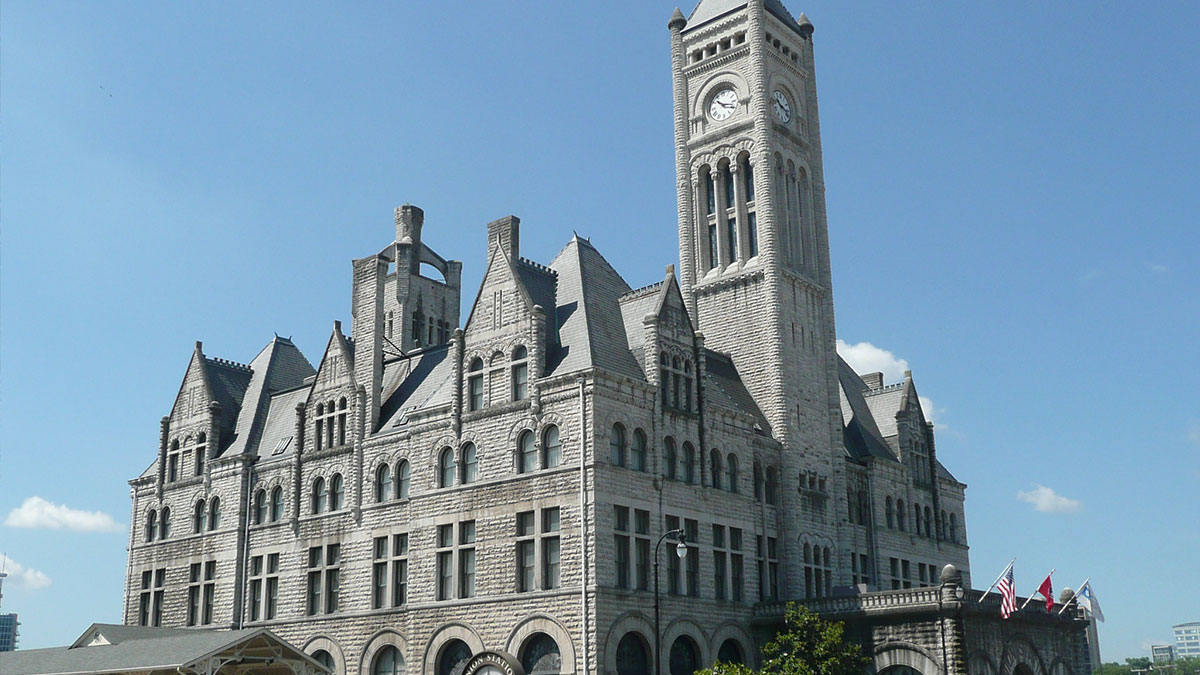
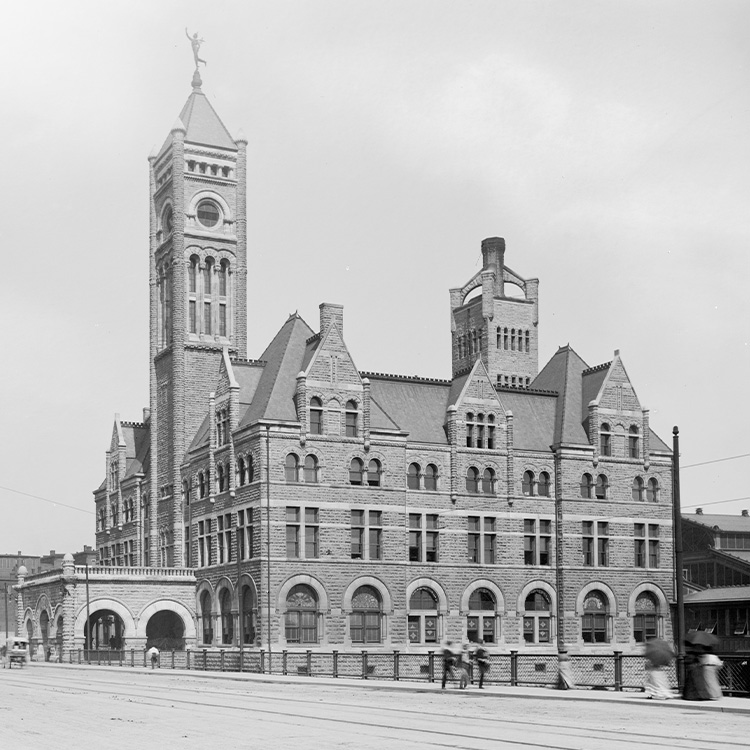
Railroad engineer Richard Montfort designed the Romanesque Revival building using Bowling Green gray stone and Tennessee marble. Its arched entrances, steep roofs, and prominent clock tower made it one of Nashville’s most recognizable buildings.
Atop the tower stood Mercury, the Roman god associated with travel and commerce.
That statue had its own eventful history. On March 22, 1952, strong winds sent the original bronze Mercury crashing to the ground.
The original statue never returned. In 1997, a new, two-dimensional version of Mercury took its place atop the tower. WPLN’s investigation into the original statue traces what happened to the bronze figure after its fall.
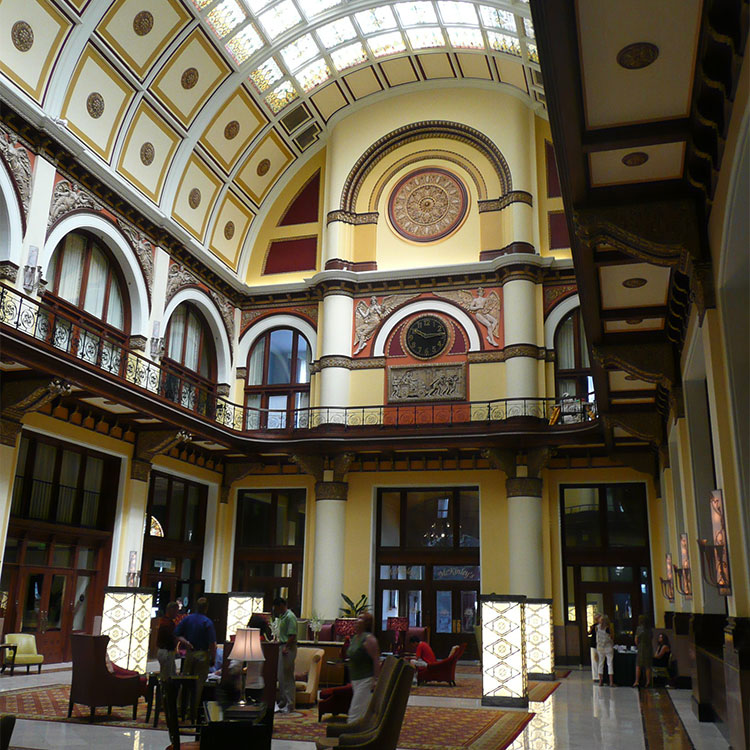
Inside, passengers waited beneath a soaring barrel-vaulted ceiling filled with stained glass, gold-leaf decorations, and elaborate architectural details.
During World War II, troop trains carried military personnel through Union Station, where families and friends gathered to see departing servicemen off.
For decades, Union Station connected the city to destinations across the country. But as automobiles and airplanes grew more popular, passenger rail service steadily declined.
By the 1970s, the building that once represented Nashville’s railroad ambitions had become a preservation problem.
The Fight to Save Union Station
Conditions eventually became so poor that Metro code violations forced the main terminal to close in 1975.
Trains kept running.
Amtrak continued using the adjoining railway facilities, and its Floridian still carried passengers between Chicago and Florida.
According to WPLN’s reporting on Nashville’s passenger rail history, the final train departed on October 8, 1979. Then-Congressman Al Gore was among those aboard.
Nashville had lost its intercity passenger rail service. Now the question was whether the historic terminal would survive.
Preservation efforts had already begun.
In May 1975, Historic Nashville launched its Save Our Station campaign, bringing attention to the deteriorating building. Supporters organized preservation activities, documented the station’s history, and advocated for its restoration.
But public campaigning alone wasn’t enough.
The federal General Services Administration had taken responsibility for the property, and restoration efforts stalled.
In 1982, Historic Nashville launched another campaign called Unite to Save Union Station. The organization also pursued legal action against the GSA, arguing that the agency had failed to meet its responsibility to prevent further deterioration and renovate the building.
Historic Nashville won the lawsuit.
The Nashville Public Library’s archival collection documents the preservation campaigns, litigation, redevelopment efforts, and extensive damage preservationists were fighting to address.
A practical solution finally emerged in 1985.
Nashville leased the terminal to Gulf Coast Development for 90 years, and federal Urban Development Action Grant funding was approved to support restoration.
The plan was to transform the railway terminal into a hotel.
One important detail was buried in that arrangement: the historic train shed was not included in the lease.
The main building had a path toward restoration. The structure beside it did not.
A Hotel Opening Didn’t End the Trouble
On December 31, 1986, Union Station reopened as a hotel.
For the first time in years, travelers were once again arriving with luggage. But instead of purchasing train tickets, they were checking into guest rooms.
Restoration work was still underway when the hotel opened. The building had been rescued from deterioration, but the business behind its new purpose faced difficulties of its own.
In 1988, financial problems forced the hotel to close.
It reopened under new ownership in 1990.
Within four years of its celebrated conversion, Union Station had already experienced another closure and another comeback.
The historic building survived, although its complicated financial history showed that saving a landmark and operating a successful business inside it were two different challenges.
The Part That Was Lost
Behind the surviving terminal once stood an extraordinary piece of railroad engineering.
Union Station’s train shed measured approximately 250 feet wide and 500 feet long, with enough room to accommodate ten full-length trains.
Its roof featured a remarkable 200-foot clear span, meaning the structure could cover an enormous area without interior supports interrupting the space.
According to the Tennessee Encyclopedia, it was the longest single-span, gable-roof structure in the United States when completed in 1900.
It was an engineering achievement that helped define Nashville’s importance as a transportation center.
But unlike the terminal, the shed never received a successful restoration.
According to the National Park Service’s historical account, a 1996 fire damaged part of the hotel and one of the train shed’s trusses. Its owners subsequently removed the shed’s roof, leaving the metal framework exposed to the weather.
The space beneath it was used for parking.
By October 2000, engineers had determined that years of deterioration had made the structure unsafe. The parking lot closed, and the shed was demolished between January and February 2001.
On July 31, 2003, the National Park Service withdrew the Union Station and Trainshed’s National Historic Landmark designation because the historic shed was gone.
The surviving terminal remains listed on the National Register of Historic Places.
Today, Nashville still has its grand passenger terminal. But the vast structure where trains once arrived and departed has disappeared.
What You Can Still See Inside
Walk into Union Station today, and the first thing worth noticing is above you.
The former passenger hall retains its 65-foot-high barrel-vaulted ceiling, with original luminous prism stained glass and gold-leaf medallions.
Those surviving details help explain why preservationists fought so hard to protect the building.
Look toward the upper walls and you’ll find 20 gold-accented bas-relief figures the hotel describes as “angels of commerce.”
Two additional relief panels depict a steam locomotive and a horse-drawn chariot. They’re fitting decorations for a place built around transportation.
Elsewhere, oak-accented doors and walls and three limestone fireplaces add to the historic interior.
Not everything you see dates to 1900.
A major renovation completed in 2007 introduced a new marble lobby floor while restoring and cleaning surviving architectural features, including the stained glass and decorative reliefs.
Union Station is just one example of Nashville’s unusual architectural history. For more stories hidden inside familiar landmarks, explore these 11 Nashville buildings with secrets most locals have never heard.
Visiting Union Station Today
The Union Station Nashville Yards is located at 1001 Broadway, Nashville, TN 37203, at the intersection of Broadway and 10th Avenue.
You don’t need to book an overnight stay to enjoy its restaurants, but the building remains an operating hotel rather than a public museum.
If you’re interested in the architecture, allow approximately 20–30 minutes to appreciate the lobby’s historic features. Contact the hotel beforehand to ask about access and photography, especially when private events are scheduled.
Stationairy serves meals in a setting surrounded by the station’s historic stonework and arched windows.
The Bar Car occupies part of the Grand Lobby where the original ticket office once stood. It offers drinks, small plates, and live music.
The hotel’s parking policy provides two complimentary hours of valet parking for Stationairy and The Bar Car patrons. Additional parking charges may apply afterward, so confirm the current terms when arriving.
For overnight accommodations, visit the official Union Station hotel website. Before booking, check the room’s accessibility features, cancellation policy, and total price.
If you’re comparing places to stay downtown, our guide to 10 Nashville hotels near Broadway that visitors keep recommending offers other options worth considering.
Our guide to 10 things you should always check before booking a Nashville trip covers other details worth reviewing.
For questions about lobby access, parking, or events, call 615-726-1001.
More than a century after Union Station first opened, visitors can still walk beneath its stained-glass ceiling and see much of the craftsmanship that made it remarkable.
The trains are gone. So is the enormous shed that once sheltered them.
But the passenger terminal remains, thanks to a preservation fight that gave one of Nashville’s grandest buildings another life.