

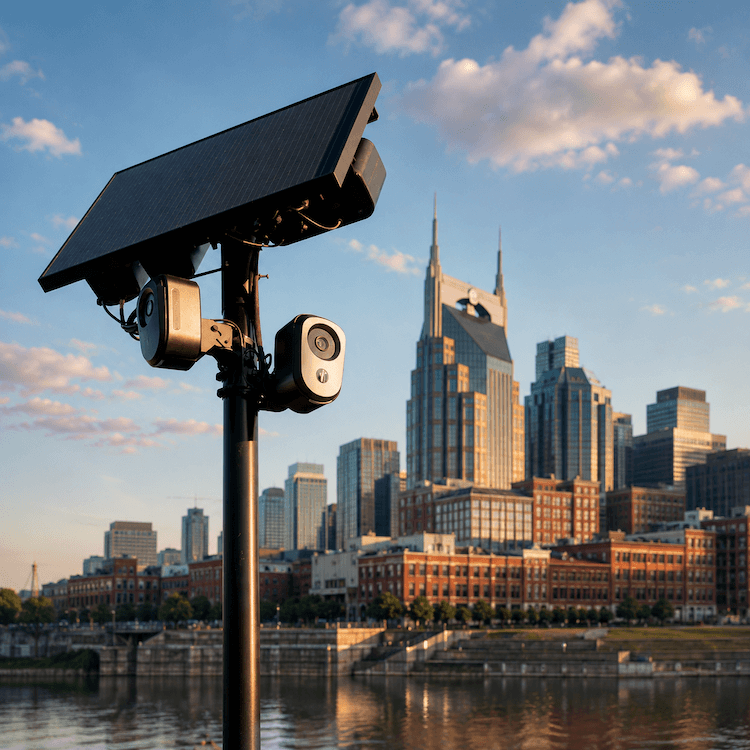
Nashville is talking about Flock cameras, and the conversation got a lot bigger than a simple yes or no.
We asked Nashville what people thought about the license plate readers popping up around the city. The response was huge, and it wasn’t close to one-sided. What came out of it was a real snapshot of how this city feels about being watched, tracked, and recorded, and it might surprise you where people actually landed.
The Argument You’ll Hear Most
If there’s one thing almost everyone agrees on, it’s this: your phone already knows more about you than a camera on a pole ever could.
People pointed out that their phones track their location, their searches, their purchases, and sometimes even listen through smart assistants. Compared to that, a camera that only reads a license plate seems almost quaint to a lot of residents.
But here’s where it gets interesting. Plenty of people pushed back on that comparison, and their reasoning is worth sitting with. A phone is a choice. You can turn it off, leave it at home, or ditch it completely. A government camera mounted on a public road isn’t optional. You can’t opt out of driving past it.
That distinction, choice versus no choice, ended up being the real dividing line in the debate. It wasn’t really cameras versus no cameras. It was consent versus no consent.
It’s Not the Camera. It’s What Happens After.
A common theme through the responses was this: the camera itself isn’t the problem. What happens with the information afterward is.
Once a license plate gets scanned, it doesn’t just disappear. It gets stored, compared against databases, and in some cases shared with other agencies entirely. That’s the part that made a lot of people uneasy, even those who said they don’t mind being seen in public.
Several residents brought up real incidents that have made headlines nationally. Officers in more than one state have been fired or criminally charged for using license plate systems to track romantic partners or exes. One widely discussed case involved an officer accused of running searches on the same vehicle more than 150 times for personal reasons.
Cases like that don’t prove the technology is bad. They prove that oversight matters just as much as the tool itself.
The Cases People Can’t Stop Bringing Up
On the flip side, plenty of Nashville residents pointed to real wins. License plate cameras have helped locate stolen vehicles, track down missing children during Amber Alerts, and in at least one recent case, helped reunite a toddler with her family within hours of a citywide search.
For a lot of parents especially, that outcome changes the whole conversation. When the choice is framed as privacy versus finding a missing child, privacy concerns tend to take a back seat.
That’s part of why this topic is so hard to settle. Both sides have real, documented examples backing up their point of view. It’s not made up outrage on either side.
The Legal Question Nobody Has Fully Answered
Here’s something that might surprise you: courts around the country haven’t actually agreed on whether this kind of tracking is constitutional.
A federal judge in Virginia recently ruled that one city’s camera network didn’t violate residents’ rights, at least not yet. Meanwhile, residents in Colorado filed a lawsuit arguing that most people caught on camera have nothing to do with any crime at all, and shouldn’t be swept into a searchable database anyway. A separate case in California accuses a camera company of sharing residents’ movement data with out-of-state law enforcement without local approval.
In other words, this isn’t settled law. It’s still being fought out in courtrooms right now, which means the rules could look very different a year from now than they do today.
So Where Does That Leave Nashville?
The honest answer is that Nashville is split, but not in the way you’d expect. Very few people said they’re against public safety. Very few people said cameras should be everywhere with zero rules either. Most of the debate lives in the middle, in questions about who gets access to the footage, how long it’s stored, whether a warrant should be required, and what happens when someone misuses the system.
If there’s one thing this conversation made clear, it’s that Nashville isn’t asking whether cameras can be useful. People already believe they can be. The real question is whether the city can be trusted to use them responsibly, and that’s a much harder thing to put to a vote.