
When people were asked what Nashville has lost that made it special, some of the answers were predictable.
Opryland.
Beloved restaurants.
Historic music venues.
Old businesses.
Affordable housing.
Easy traffic.
Parking that didn’t require taking out a second mortgage.
But after reading through hundreds of responses, one answer appeared more than any other:
Its soul.
The Word That Kept Appearing
Soul.
Heart.
Character.
Identity.
Authenticity.
Those words surfaced over and over again.
Many commenters struggled to point to a single building, business, or attraction because what they miss feels larger than any one place. They described a Nashville that once felt personal, local, and connected. A city where musicians, business owners, neighbors, and residents felt like part of the same community.
The complaint wasn’t simply that Nashville changed.
It’s that many people believe it changed into something unrecognizable.
Opryland Became The Symbol
No specific place received more mentions than Opryland USA.
Decades after its closure, the amusement park still occupies a special place in Nashville’s collective memory.
What’s fascinating is that many commenters weren’t really talking about roller coasters.
They were talking about what Opryland represented.
Family traditions.
Affordable entertainment.
A uniquely Nashville experience.
A place built for locals rather than visitors.
In many ways, Opryland has become shorthand for a version of Nashville people feel was lost long ago.
Music City Without The Music?
Another recurring complaint centered on country music itself.
Many commenters argued that traditional country music has been pushed aside by commercial trends, celebrity branding, and tourism-focused entertainment. Steel guitars, fiddles, songwriter culture, and the sounds that once defined Nashville were repeatedly mentioned as things people feel are disappearing.
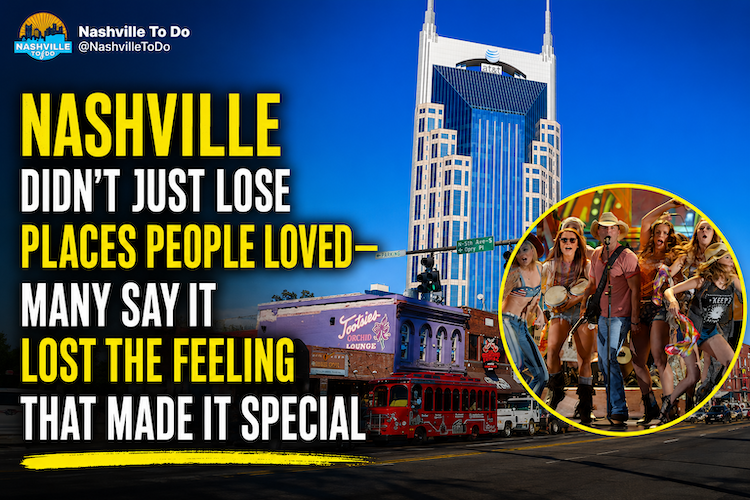
Several even suggested that Broadway has become less about music and more about alcohol, branding, and social media.
For a city built on its musical reputation, that’s a striking criticism.
The Growth Debate Never Goes Away
No Nashville conversation stays away from growth for long.
Many residents pointed directly at developers, tourism, population growth, and local leadership as reasons the city feels different today.
Traffic.
High-rise construction.
Corporate relocations.
Crowded neighborhoods.
Rising costs.
The complaints varied, but they all pointed toward the same concern:
Has Nashville grown so fast that it lost the very qualities that made people want to move here in the first place?
Affordability Is More Than A Financial Problem
Several comments focused on housing costs, parking prices, and the general expense of living in Nashville.
But these complaints often felt emotional rather than purely economic.
For longtime residents, affordability isn’t just about money.
It’s about who gets to stay.
It’s about watching favorite businesses close, neighbors move away, and communities change beyond recognition.
When people say Nashville has become unaffordable, they’re often talking about losing a sense of belonging.
The Nashville People Remember
Throughout the discussion, people reminisced about old restaurants, music venues, shopping centers, radio stations, local landmarks, and gathering places.
Some of those places have been gone for decades.
Yet they continue to surface whenever people talk about Nashville’s past.
That nostalgia reveals something important.
Most people aren’t asking Nashville to stop growing.
They’re asking whether growth had to come at the expense of so much local character.
What The Comments Really Reveal
At first glance, this discussion looked like a list of closed attractions and favorite memories.
But it quickly became something deeper.
The overwhelming theme wasn’t Opryland.
It wasn’t country music.
It wasn’t traffic.
It wasn’t parking.
It was identity.
Many residents feel that Nashville has become a city designed for tourists, developers, and newcomers while the culture that built Music City slowly fades into the background.
Whether that’s entirely true is open to debate.
What’s not debatable is how many people feel it.
Because when asked what Nashville has lost, the most common answer wasn’t a place.
It was the feeling of being Nashville.